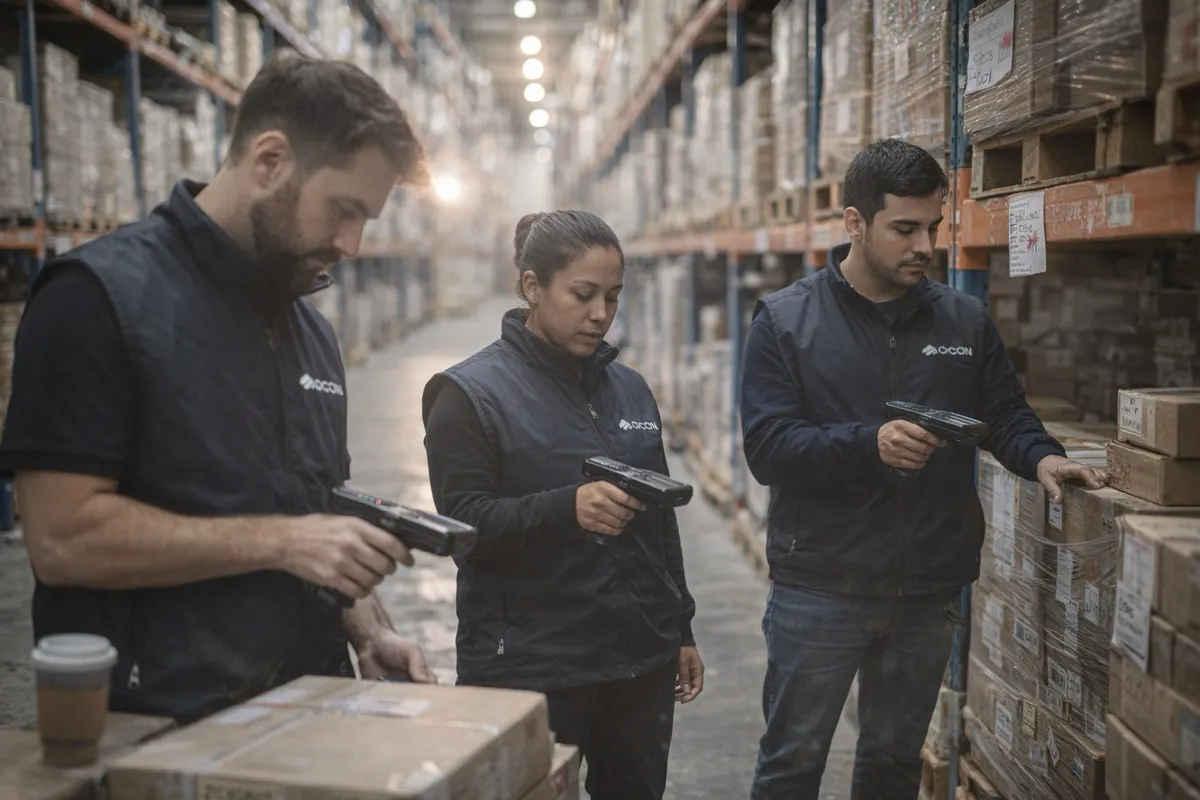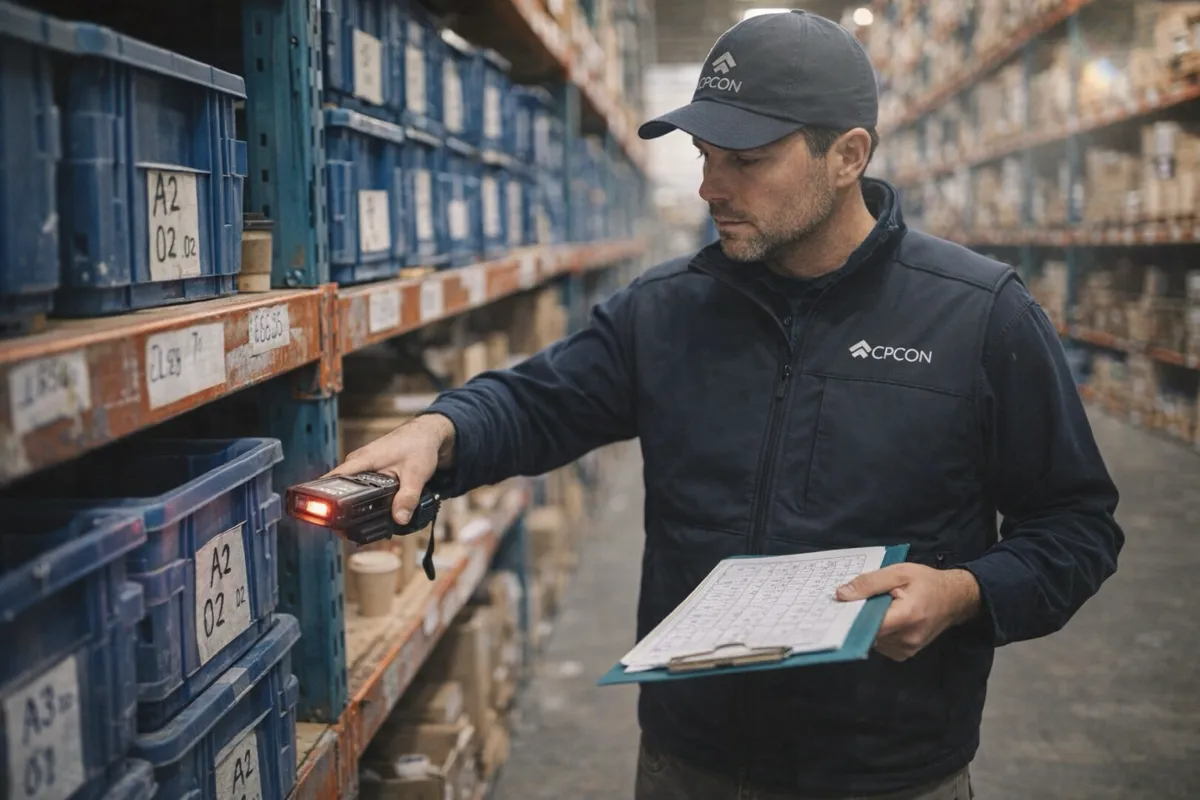
Tools do not replace count design. In a shutdown-free industrial cycle count, scan, RFID, and vision are a method stack—chosen to fit location types, movement rules, and WMS hooks. Treating any single tool as a magic accuracy machine is how programs fail on the floor.
Where interactive demos appear on CPCON experiences, treat numbers and IDs as labeled simulation, not field proof.
Illustrative; sim where noted
- 1. Barcode / scan
Default for rolling location identity and qty on most industrial bins.
- 2. RFID
Fit when density blocks line-of-sight. Industrial stocktake method only—not FA tagging.
- 3. Vision assist
Demo IDs and quantities are labeled simulation, not a plant accuracy score.
Tools serve the design
Before picking hardware, lock:
- Which locations are in today’s slice.
- How live picks are handled during the count.
- What triggers a recount vs a book adjustment.
See Industrial Cycle Count Program Design and Cycle Counts While Picks Are Live. Technology cannot fix an undefined cutoff.
Barcode and scan for rolling location counts
Scan-based counting remains the default for many industrial locations:
- Confirms the location identity before qty is taken.
- Fits bin-level rolling counts in keep-running programs.
- Integrates cleanly with most WMS workflows.
Limits show up in dense, poorly labeled, or highly nested locations—and when labels are damaged. Scan discipline still depends on blind-count rules and recount thresholds.
RFID where dense industrial locations justify it
RFID can help when many tagged items sit in a location and line-of-sight scanning is slow. It is a fit decision, not a product hero:
- Works best when tags, portals/readers, and exception handling are designed together.
- Still needs location control and variance investigation.
- Is overkill for sparse bulk locations that scan fine with barcode.
This article does not sell fixed-asset durable tagging programs. Industrial stocktake method only. Hard wall vs FA tagging services and Inventory Reality.
Vision and assisted capture as labeled sim
Camera-assisted or vision workflows can support hard-to-reach or high-speed environments. When CPCON shows an interactive or demo path, label it as simulation: sample IDs, quantities, and variances are illustrative. Field work still follows written count controls.
Do not confuse a smooth demo with proven plant accuracy. No invented percentages belong here.
Stack selection checklist
| Question | Stack implication |
|---|---|
| Can counters see and reach every unit? | Prefer scan; add RFID if density blocks line-of-sight |
| Do picks continue during the count? | Prioritize cutoff rules before tool choice |
| Are labels reliable? | Fix labeling/process before buying new capture |
| Does WMS accept the export format? | Choose tools that close the loop into the book of record |
| Is leadership asking for a “score”? | Define measurement first; tools do not invent a trustworthy % |
For the procedure this stack sits on, use How to Run Warehouse Cycle Counts. For the freeze vs keep-running decision, see Shutdown vs Keep-Running Cycle Counts.
To see the stack in a shutdown-free industrial cycle count, see how CPCON runs a shutdown-free cycle count.
Frequently asked questions
When is RFID overkill?+
Sparse locations, reliable barcodes, and low density—RFID adds cost without changing the bottleneck.
What does “labeled sim” mean?+
Demo quantities and IDs are illustrative. They are not a client result and not a promise of field accuracy.
Will this replace our cycle count SOP?+
No. Use How to Run Warehouse Cycle Counts for the procedure. This article only stacks capture methods on top of that discipline.
Fixed-asset tagging?+
Out of scope. Hard wall vs FA tagging services and Inventory Reality.