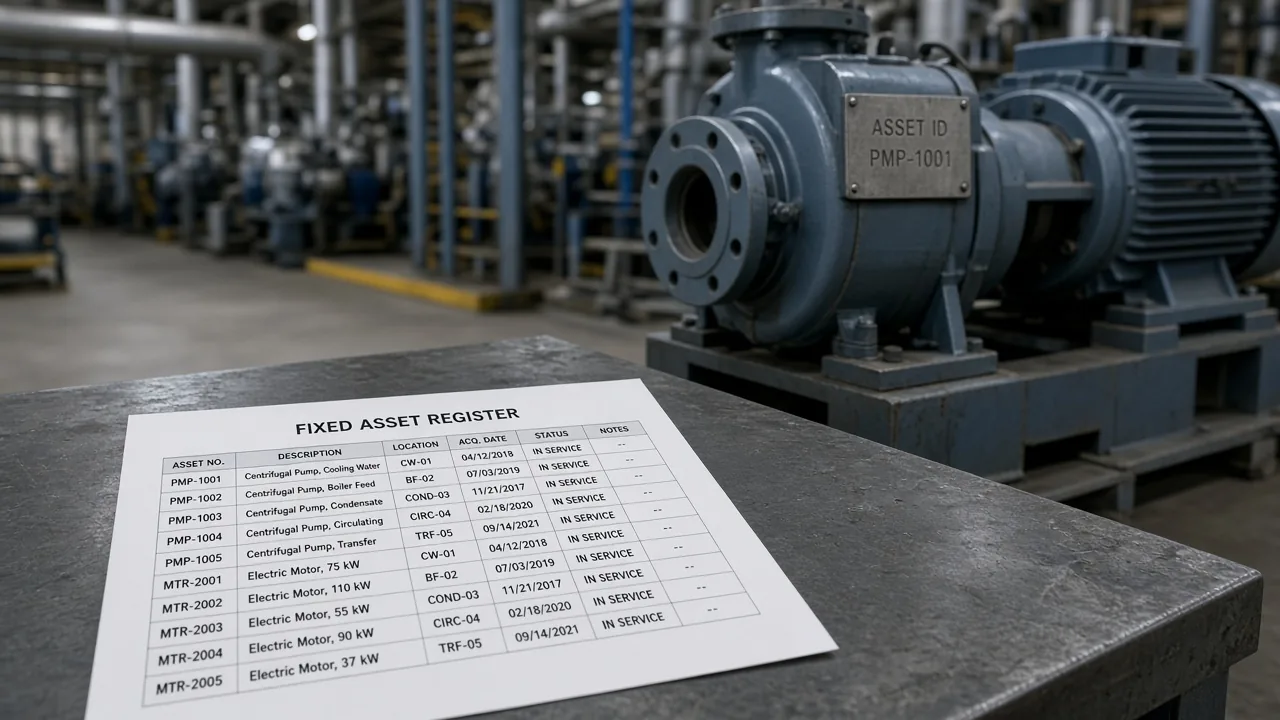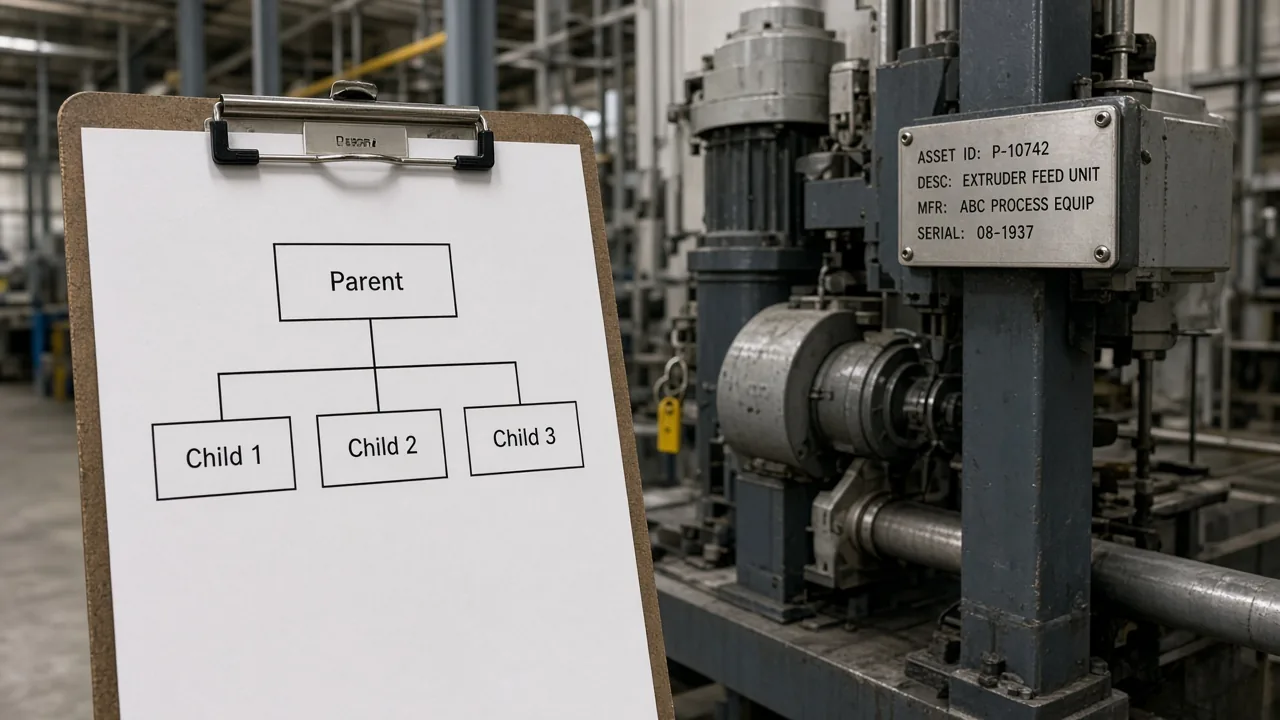
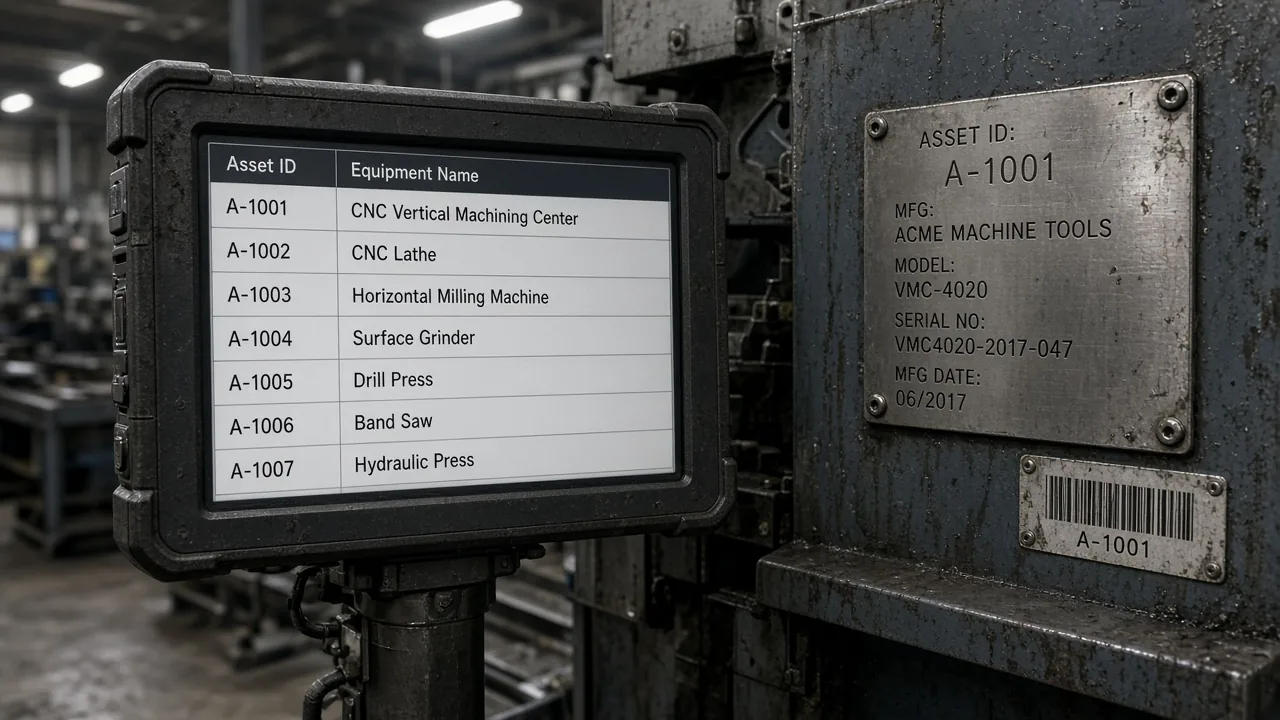
Fixed asset tagging standardization is the set of rules that make every capitalized tangible asset share one identity language across the register, the floor, and the evidence file. It covers naming, classes, IDs, register fields, the CAPEX-to-tag handoff, and the packs controllers keep for ICFR. It is not a media or scanner how-to—that belongs to the asset tagging guide. It is not a service pitch. This page owns standardization rules and register fields for industrial PPE.
(a) IAS 16 and ASC 360 do not require a physical tag. Tagging is an ICFR and operational evidence mechanism. (a) SEC FR-77 still requires records that accurately reflect transactions and dispositions of assets, and reasonable assurance over unauthorized acquisition, use, or disposition. Standardization is how industrial teams turn that recordkeeping duty into fields, IDs, and evidence packs that survive audit.
Purpose and scope
(c) Bring every capitalized tangible fixed asset into a consistent identity scheme so that:
- The fixed-asset register can support ICFR evidence for existence and completeness of PPE (and feed valuation and presentation workflows).
- Componentization and subnumbering (parent–child) match the entity’s accounting policy under IFRS and/or US GAAP.
- Floor teams, controllers, and auditors share one language for “what is tagged,” “what sits on the register,” and “what an evidence pack looks like.”
In scope (c): tangible PPE within IAS 16 / ASC 360 scope (held for use more than one period); decisions on register fields, ID schemes, naming, class lists, CAPEX-to-tag flow, and standardization program phases; control checkpoints mapped to assertions—existence, completeness, rights/obligations, valuation/allocation, presentation/disclosure (a) PCAOB AS 1105.11.
Out of scope: full house SOPs (count scripts, scanner apps, SLA calendars) → FA Methods; tax depreciation lives and insurance schedules (they may consume the same IDs; they are not owned here); intangibles, inventory, and biological assets outside PPE; barcode/RFID media selection and print workflows → asset tagging guide; the must-tag vs other-means screen → fixed asset tagability criteria.
| Tagging is (c) | Tagging is not (a) |
|---|---|
| An operational / ICFR mechanism to identify assets for verification and register integrity | A recognition criterion in IAS 16 or ASC 360 |
| Evidence support for existence (and, with good population design, completeness) | Proof of valuation, rights, or useful life by itself |
| Linked to register numbers when assets are separately tracked | Mandated metal/RFID technology by any standard searched |
(a) IAS 16.9: the unit of measure for recognition is not prescribed—judgment applies. (a) Nothing in IAS 16 or ASC 360 defines “tagability,” RFID, or barcode programs.
Naming, class, ID, and register-field rules
These are (c) recommended rules so registers survive audit. Align final wording with client FA Methods for the house SOP.
Naming and descriptions (c)
| Field | Rule (c) | Why |
|---|---|---|
| Short description | Noun + key attribute + location hint (e.g., Pump-centrifugal-45kW-Bldg3) | Floor-lead recognition |
| Long description | Vendor, model, serial, project # | Rights and valuation support docs |
| Language | One corporate language + local optional | Consolidation / audit sampling |
| Forbidden | Vague (Equipment, Misc, Various) | Fails inspection usefulness |
Asset classes (c) with standard hooks (a)
| Rule (c) | Link to standards |
|---|---|
| Class list mirrors FS disclosure classes (land; buildings; machinery; vehicles; fixtures; etc.) | (a) IAS 16.37 examples; (a) ASC 360-10-50-1 major classes |
| Land vs buildings always separable IDs | (a) IAS 16.58 |
| Class drives default useful-life / depreciation-method tables (estimates remain judgment) | (a) IAS 16.50–62; ASC 360-10-35 |
| Do not invent classes just for tags—tags follow class | Avoid presentation noise |
For how those classes sit on the master file itself, see the fixed asset register guide.
ID schemes (c)
| ID type | Recommended practice (c) | Notes |
|---|---|---|
| Tag ID | Permanent unique code on asset (barcode / RFID / engraved) | Human-readable check digits help floor |
| Register main number (ANLN1-style) | Stable parent economic unit | Implementation language—not an IAS/ASC term |
| Register subnumber (ANLN2-style) | Component / inspection / remainder when policy splits | Implementation language—not an IAS/ASC term |
| Serial / VIN | Capture as attribute; use as Tag ID only if unique and controlled | Dual IDs OK if mapped 1:1 |
| Never | Recycle Tag IDs for live assets; silent reuse after disposal without retention rules | Breaks audit trail (a) ICFR disposition records |
Media choice (which plate, which scanner, which print stock) is owned by the asset tagging guide. This page locks the identity rules those media must obey.
Register fields that survive audit (c)
Minimum viable master-data set, mapped to assertions:
| Field | Existence | Completeness | Rights | Valuation | Presentation |
|---|---|---|---|---|---|
| Unique asset # (parent) | ● | ● | ● | ||
| Subnumber (child) | ● | ● | |||
| Tag ID / “untagged-alt” flag | ● | ● | |||
| Description | ● | ● | |||
| Asset class | ● | ● | |||
| Cost center / location | ● | ● | |||
| Cap date / in-service date | ● | ||||
| Acquisition cost / accum. depr. | ● | ||||
| Useful life / depr. key | ● | ||||
| Serial / title doc ref | ● | ||||
| Source doc (PO / invoice / CIP WBS) | ● | ● | ● | ||
| Status (active / idle / held-for-sale / retired) | ● | ● | ● | ||
| Last physical verify date + result | ● |
(a) ICFR requires records that accurately reflect transactions and dispositions—status and retirement docs matter as much as tags. A tag without a register line (or a register line without a tag or documented alternative) breaks the existence link; keep an exception report until remediated (c).
CAPEX-to-tag flow
(c) Standardization must reconcile additions above the entity capitalization threshold into the FA master—with a tag when tagability says yes, or with a named alternative existence control when it says no. The dollar gate is entity policy; IAS 16 and ASC 360 do not prescribe a global amount.
Invoice / PO / CIP
        │
        ▼
[Capitalization policy threshold]  ← entity policy (c); not an IAS/ASC $ amount
        │
        ├─ Below → Expense (or aggregate policy if elected) ──► no FA tag needed
        │
        └─ At/above → FA create
                │
                ├─ Tagability YES → assign Tag ID + register fields
                └─ Tagability NO  → assign Register ID + alternative existence control
(c) Run a monthly (or period) exception: additions above threshold without an FA master record. That report is a completeness control tied to (a) ICFR recordkeeping—not a substitute for physical verification. Untagged classes still need CAPEX-to-register, CIP close, and purchase cut-off controls; floor→book only finds unrecorded assets inside the population you chose to walk.
When to lean tag vs GIS / title packet / meter register is the tagability criteria decision—not this page. Here the lock is: every capitalized line gets a register identity and a named existence path before in-service.
Standardization phases checklist
(c) CPCON recommended method. Physical-verify cadence is entity-set—not prescribed by IAS 16 or ASC 360. Do not invent frequencies.
Phase 0   Mandate & policy lock
Phase 1   Class taxonomy & tagability matrix
Phase 2   ID scheme & register field standard
Phase 3   Componentization rules by class
Phase 4   Pilot (one site / one class)
Phase 5   Rollout & remediation of ghosts/orphans
Phase 6   BAU controls & SOX evidence calendar
Roles (c): Controller / FA Accounting owns policy (cap threshold, component election), assertion mapping, and register ownership. FA Methods owns tagging SOPs and tools. Floor lead applies/verifies tags and logs exceptions. Internal audit / SOX samples evidence packs. IT / ERP configures main/sub numbers, CAPEX→FA interfaces, and locks unused fields. External audit uses management evidence and may inspect assets (a) AS 1105.15.
Phase checkpoints (c) with assertion hooks (a)
Phase 0 — Mandate & policy lock
Confirm reporting framework(s): IFRS, US GAAP, or dual. Document component accounting policy ((a)/(b) IFRS requires separate depreciation of significant-cost parts; US GAAP permits component depreciation and does not require it — KPMG 2023; EY Dec 2024 (b)). Freeze capitalization threshold and class list for the program window. Checkpoint — Presentation: class list aligns to disclosure classes.
Phase 1 — Tagability matrix
Score each class (see tagability criteria). Name alternative controls for untagged classes. Checkpoint — Existence: every material class has a named existence control. Checkpoint — Completeness: CAPEX-to-register control named for all classes.
Phase 2 — ID & fields
Approve Tag ID format; ban recycling rules. Implement the register field minimum above. Checkpoint — Rights: title / lease / serial reference field mandatory for titled classes (vehicles, real estate).
Phase 3 — Component / subnumber rules
Per class: “split if…” criteria under the entity’s IFRS or US GAAP policy. Document cost-allocation method at capitalization (specific ID / relative FV / other reasonable). Checkpoint — Valuation: useful-life tables by child; review cadence (a) IAS 16.51 at least annual for IFRS.
Phase 4 — Pilot
One site + one or two classes. Book→floor and floor→book samples. Exception types: missing tag, ghost, orphan cost, wrong child. Checkpoint — Existence & Completeness: pilot evidence pack reviewed by Controller + SOX.
Phase 5 — Rollout & remediation
Ghosts (book, no floor): investigate → retire / relocate / correct. Floor orphans (floor, no book): investigate → capitalize if criteria met / expense / inventory. Untagged-over-threshold list: remediate or document compensating control. Checkpoint — Completeness: open CAPEX/CIP aged items cleared or explained.
Phase 6 — BAU
New asset workflow: create FA → (subnumbers if required) → tag (if required) → in-service. Periodic verify by risk class (entity sets frequency). Disposal: clear tag → retire children → update dispositions (a) ICFR records. Checkpoint — All assertions: annual ICFR evidence index.
Evidence packs and ICFR recordkeeping
(a) SEC FR-77 frames ICFR as policies and procedures that maintain records of asset transactions and dispositions, and that provide reasonable assurance regarding unauthorized acquisition, use, or disposition that could materially affect the financial statements. (a) PCAOB AS 1105.11 names the assertions those packs must support. Floor observation is point-in-time (a) AS 1105.16—packs must also cover creation, disposition, and policy.
| Pack (c) | Contents | Primary assertions |
|---|---|---|
| A — Policy | Cap policy, component policy, tagability matrix | Valuation, Presentation |
| B — Creation | PO / invoice / CIP settlement, FA master screenshot, tag photo/log | Completeness, Rights, Existence |
| C — Component split | Cost allocation worksheet, UL memo | Valuation |
| D — Physical verify | Count instructions, sample list, results, reconciliations, sign-offs | Existence, Completeness |
| E — Disposition | Retirement form, buyer docs, tag retirement, GL posting | Existence, Rights, Valuation |
| F — SOX summary | RCM rows linking controls → assertions → evidence location | ICFR assessment support (a) FR-77 |
| Assertion (a) | Example control (c) | Evidence |
|---|---|---|
| Existence | Periodic tagged count; book→floor | Pack D |
| Completeness | CAPEX→FA reconciliation; floor→book in scope | Pack B + D |
| Rights | Title / lease file linked to asset # | Pack B |
| Valuation | Component UL review; depr. recalculation; impairment indicators | Pack C + accounting memos |
| Presentation | Class mapping to disclosure; held-for-sale checklist | Pack A + period-end RCM |
What a tag + register program can support vs cannot alone prove (c) derived from (a) AS 1105 and FR-77:
- Existence: physical ID matches register line; floor-to-book / book-to-floor—not that NBV is correct or unimpaired.
- Completeness: tagged/located items in the defined population are on the register—not that all owned assets entered scope without CAPEX-to-register controls.
- Rights: tags show custody/location weakly—not legal title (need purchase docs, titles, leases, lien searches as relevant).
- Valuation: supports identity of the unit being depreciated—not useful life, salvage, component split, or impairment conclusions.
- Presentation: class / location fields aid roll-forwards—not disclosure completeness by themselves (a) ASC 360-10-50 / IAS 16.73.
FAQ
Is this the same as the asset tagging guide?
No. The asset tagging guide owns media, tech, and how-to apply identifiers. This page owns standardization rules—naming, classes, IDs, register fields, CAPEX-to-tag flow, phases, and ICFR evidence packs.
Do IAS 16 or ASC 360 require a physical tag?
(a) No. Neither standard mandates metal tags, RFID, barcodes, intervals, or sampling percentages. Tagging is an ICFR / operational evidence mechanism. (a) SEC ICFR still requires accurate records of asset transactions and dispositions.
How is this different from buying asset tagging services?
This is an informational controls playbook for industrial FA teams—rules and register fields—not a services page and not an IT asset-tagging pitch. No soft CTA to tagging services appears here; tagging services remain detargeted.
Where do “must tag vs other means” decisions live?
In fixed asset tagability criteria (forward link). This page assumes that matrix exists and locks the register and ID rules that follow.
How does this relate to the fixed asset register?
Standardization defines the field and ID rules the register must hold. Day-to-day register structure and maintenance are covered in the fixed asset register guide.
Is this about grocery, retail, or IT laptop inventories?
No. Framing is industrial fixed assets / PPE for controllers, auditors, and floor leads. Grocery and retail shelf programs, and ITAM-only laptop fleets without FA register linkage, are out of scope.