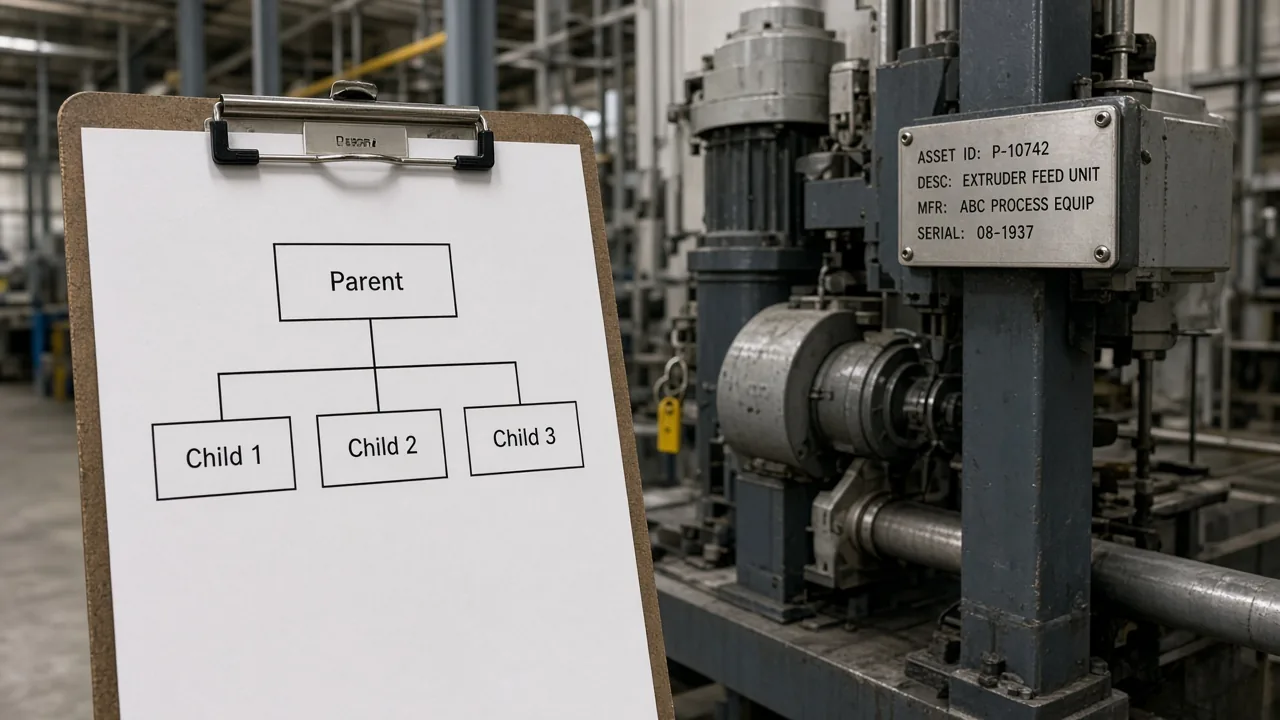
Fixed asset parent child subnumbering is how the register keeps one economic item as a stable parent and tracks significant parts, inspections, and remainders as children under it. Controllers use it so depreciation, replacements, and floor checks hit the right unit—without renaming the whole asset every time a roof, drive, or overhaul turns over.
This page owns register structure: parent vs child numbers, when to open a child, how cost and useful life sit on each line, how tags map, and what evidence packs follow replacements. It does not own the IAS 16 component rule itself—that lives on the live IAS 16 component approach article. Energy-sector componentization patterns stay on asset componentization for energy utilities. SAP field and FI-AA vs plant-maintenance gaps stay on the SAP component accounting gap and SAP fixed asset data guide. Link those; do not clone them here.
For which classes need a physical tag at all, see fixed asset tagability criteria. For naming, ID rules, and CAPEX-to-tag flow, see fixed asset tagging standardization. Day-to-day master-file hygiene sits in the fixed asset register guide. Media and how-to apply identifiers stay in the asset tagging guide.
What parent–child subnumbering is (and is not)
(a) Accounting standards speak of an “item” of PPE and of “parts” or “components.” They do not define “parent,” “child,” or ERP field names. (c) Subnumbering is an implementation choice: one stable main number for the economic unit, and child numbers for the parts or inspections you depreciate or retire separately.
| Parent–child is (c) | Parent–child is not (a) |
|---|---|
| A register structure that operationalizes component accounting and replacement tracking | A recognition criterion in IAS 16 or ASC 360 |
| A way to keep one economic identity while parts turn over | Proof of valuation, rights, or impairment by itself |
| Compatible with physical tags on movable children | A requirement to affix a tag (IAS 16 / ASC 360 do not require tags) |
| Subledger precision under one PPE line on the face of the statements (b) | A separate financial-statement line for every child |
(c) Plain-English field mapping (implementation language, not IAS/ASC terms): treat the parent as the main asset number (SAP-style ANLN1) and each child as an asset sub-number (SAP-style ANLN2). Standards say “item” and “parts,” not those field names—see the SAP fixed asset data guide for system detail without turning this page into an SAP how-to.
Why the register needs a tree
Without children, one blended line often hides three different lives: structure vs roof, airframe vs engines, frame vs drive. When a part is replaced, the register either double-counts cost or silently loses the old carrying amount. Parent–child subnumbering keeps:
- One parent as the economic unit everyone recognizes (building, line, aircraft).
- Children for significant parts, major inspections, and remainders that need their own cost, useful life, or retirement event.
- Stable parent identity across replacements—retire and open children; do not renumber the parent for every part change. (c)
That structure supports existence testing (match floor to the right child), completeness of CAPEX into the tree, and valuation workflows that need to know which unit’s life or cost changed—without claiming the tag proves net book value. (a)/(c)
Policy spine before you open children
Lock the reporting framework and the component policy before inventing subnumbers. (a) Under IFRS, each part of an item of PPE with a cost that is significant relative to the total cost of the item shall be depreciated separately (IAS 16.43–47). (a)/(b) Under US GAAP, component depreciation is permitted but not required—see KPMG, IFRS vs. US GAAP: PP&E Component approach (2023) and EY, US GAAP versus IFRS: The basics (Dec 2024 component note) (b). Dual reporters often align the subledger to the IFRS path to avoid two books; that alignment is a policy choice, not a tag rule. (b)/(c)
Deep rule text, examples, and standard citations stay on IAS 16 component approach. This page only needs enough policy spine so the register tree matches what accounting elected.
Also freeze (c): capitalization threshold (entity policy—no universal dollar invented here), class list, cost-allocation method at capitalization (specific identification, relative fair value, or other reasonable method per firm guidance (b)), and whether major inspections become non-physical children.
When to open a child (decision table)
(c) Use this screen after policy is locked. IFRS “must” paths below are (a); US GAAP “may” paths are (a)/(b) elections.
| Situation | Open a child? | Tag the child? |
|---|---|---|
| Part cost significant vs item total and different useful life or pattern | Yes — IFRS requires separate depreciation (IAS 16.43–45); US GAAP if elected | Tag if movable / separately verifiable; structure-only children often use location + drawing ID instead |
| Major inspection / overhaul that will recur across periods | Yes as a non-physical component when IFRS or built-in overhaul policy requires (IAS 16.14) | No physical tag; link work order / inspection packet |
| Significant parts with the same life and method | May group (IAS 16.45) | One tag on the assembly if the class is must-tag |
| Individually insignificant remainder | Remainder on parent or residual subnumber (IAS 16.46) | Tag parent assembly if tagable |
| Day-to-day repair / consumable | No — expense (IAS 16.12 path) | N/A |
| Whole item disposal | Retire all open children under the parent | Clear tags per disposition pack |
Must-tag vs other-means for a class remains the tagability criteria decision. Here the lock is: once a child exists, its identity and evidence path are named before in-service. (c)
Register fields that make the tree auditable
(c) Minimum fields on parent and children (names vary by ERP; concepts do not):
| Field / concept | Parent | Child |
|---|---|---|
| Main asset number | Stable economic ID | Same as parent |
| Subnumber | Often 0000 / blank for “main/remainder” | Unique per part / inspection / remainder |
| Description | Item name (Building 12, Line 4) | Part or inspection name (Roof, HVAC, Drive, Dry-dock 2026) |
| Cost / capitalized amount | Total or remainder per policy | Allocated part / inspection cost |
| Useful life & depreciation key | May hold remainder only | May differ by child |
| Cap / in-service dates | Item dates | Child dates (inspection children often start at overhaul) |
| Location / cost center | Usually inherited | Override when part moves |
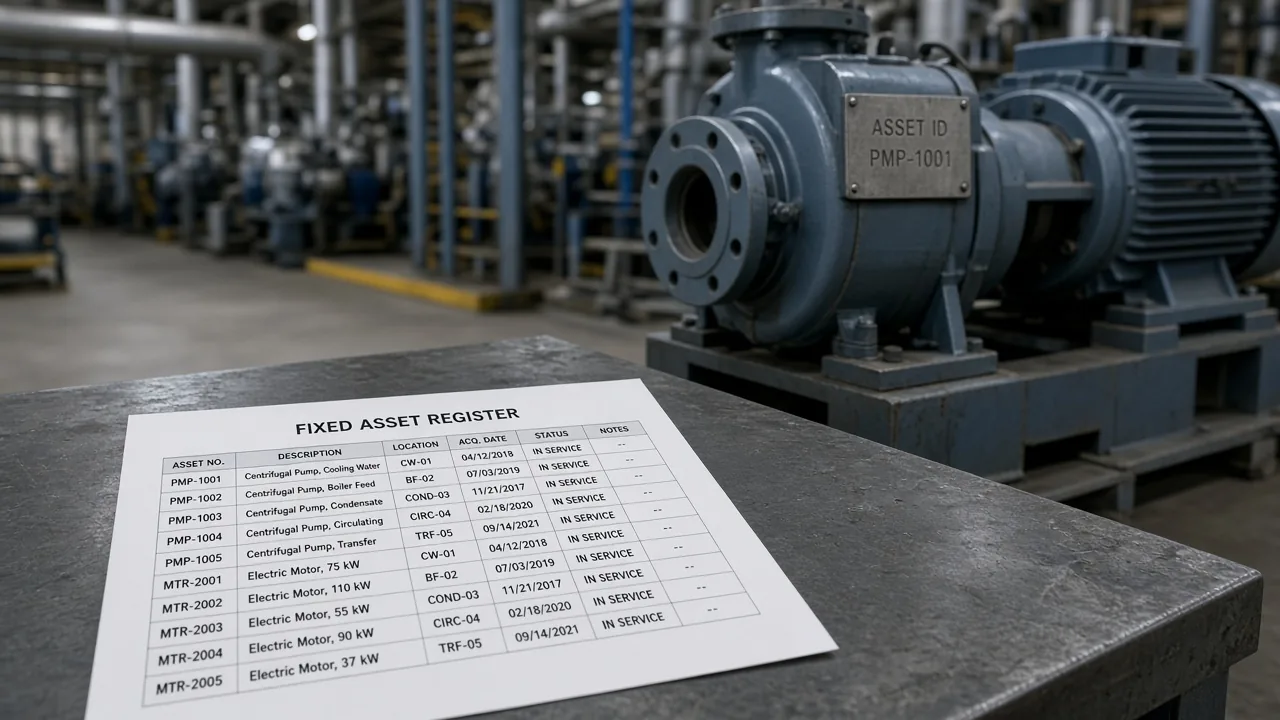
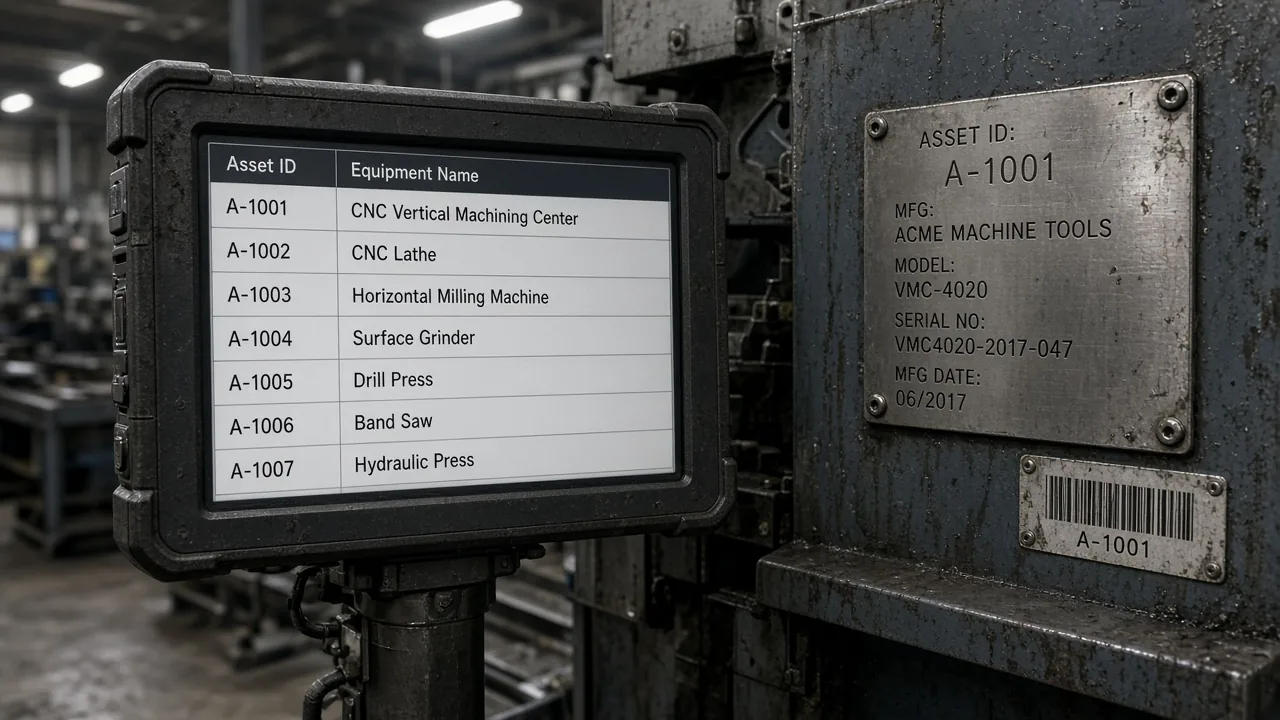
| Physical Tag ID | Optional on parent assembly | Map to parent+child (or to child when parts are separately counted) |
| Status | Active / retired | Active / retired independently |
Media choice for the physical mark stays in the asset tagging guide. Field and naming rules that apply across the program stay in tagging standardization.
Worked examples (structure only)
(c) Illustrative trees—not client data, not invented savings:
Building
- Parent: Building 12
- Child 0000 — Structure / remainder
- Child 0001 — Roof
- Child 0002 — HVAC
- Child 0003 — Elevators
Packaging line
- Parent: Packaging Line 4
- Child 0000 — Frame / remainder
- Child 0001 — Main drive (Tag T-88901)
- Child 0002 — Control cabinet (Tag T-88902)
Energy plant patterns (units, major inspections, regulated contexts) belong on asset componentization for energy utilities—link out; do not retell that vertical here.
Replacement and retirement flow
(a) Under IFRS, when a part is replaced, capitalize the new cost if recognition criteria are met and derecognize the replaced part’s carrying amount (IAS 16.13, 70)—even if that part was not separately depreciated before. Replacement cost may indicate the old amount when historical cost of the part is unknown. (c) In a subnumbered register:
- Capitalize the new child (new subnumber).
- Retire the old child; keep the parent number stable.
- Update Tag ID maps and disposition evidence.
- On disposal of the whole item, retire every open child under that parent.
(b) Firm commentary notes that US GAAP without a component approach may capitalize a replacement without derecognizing the old amount in some composite/group settings—document your election so floor and accounting do not fight each other. That opinion does not rewrite IAS 16.70 for IFRS reporters.
Tags, floor counts, and what children change
Parent–child does not invent a new recognition rule. It changes which register line a floor check or retirement hits. (c)
- Movable significant children often carry the durable tag; the parent may be location or structure only.
- Non-physical inspection children never get a plate—they get a work-order link and a cost component.
- A count still proves existence only for the population and date you designed (a) (observation is point-in-time). It does not prove useful life, impairment, or title.
Class-level must-tag vs GIS/title/meter alternatives remain on tagability criteria. Ghost / book-without-floor patterns remain on ghost asset detection.
ICFR evidence packs for the tree
(c) Keep packs that match assertions—not a full SOX 404 playbook (see fixed asset existence assertion and SOX 404 for ICFR framing).
| Pack | Contents | Primary assertions |
|---|---|---|
| Policy | Component election (IFRS path vs US GAAP election), cap threshold, class list | Valuation, Presentation |
| Creation | CAPEX / CIP settlement, cost allocation to children, register screenshots | Completeness, Rights |
| Split / change | Memo for new children, UL keys, allocation worksheet | Valuation |
| Physical verify | Sample tied to parent+child (or tag), results, reconciling items | Existence, Completeness |
| Replacement / disposition | Retirement of old child, new child setup, tag clear/apply, GL posts | Existence, Rights, Valuation |
(a) SEC ICFR still expects records that reflect transactions and dispositions and controls over unauthorized acquisition, use, or disposition. The tree is how industrial PPE makes those records specific enough to test.
How this page sits in the cluster
| URL | Owns |
|---|---|
| Tagability criteria | Which classes get a physical tag vs other existence means |
| Tagging standardization | Naming, IDs, register fields, CAPEX-to-tag, evidence packs |
| This page — parent child subnumbering | Register parent/child tree, split rules, replacements, tag mapping to subnumbers |
| IAS 16 component approach | Standard-level component depreciation rules |
| Energy componentization | Vertical patterns for energy / utilities |
| SAP component gap / SAP FA data | System implementation detail |
| Asset tagging guide | Media / tech how-to |
| Register guide | Day-to-day register hygiene |
FAQ
Is parent–child the same as IAS 16 component accounting?
No. IAS 16 tells you when significant parts shall be depreciated separately (a). Parent–child subnumbering is the register design that implements that policy (and US GAAP elections) (c). Read the rule on IAS 16 component approach.
Does US GAAP require the same tree as IFRS?
(a)/(b) IFRS requires separate depreciation of significant-cost parts; US GAAP permits component depreciation and does not require it — KPMG 2023; EY Dec 2024 (b). Your documented election drives whether children are mandatory or elective.
Do ANLN1 / ANLN2 mean anything in the standards?
No. They are SAP-style implementation field names (c), not IAS/ASC terms. See the SAP fixed asset data guide.
Must every child have a physical tag?
No. Tagability is class- and control-design driven (c); inspection children are often non-physical. IAS 16 and ASC 360 do not require tags (a).
What happens on replacement?
Open a new child, retire the old child, keep the parent stable (c); under IFRS derecognize the replaced carrying amount (a) IAS 16.70.