Winery Inventory Management Software: A Buyer's Guide
Choosing winery inventory management software is a high-stakes decision. This guide compares spreadsheets, barcode systems and RFID bottle-level tracking fairly, then gives you a buyer's checklist so you can match the right approach to your cellar.
Rafael Dias
President/CEO MX, CDMX
Rafael leads CPCON's operations in Mexico and Latin America, specializing in RFID technology implementation and inventory management solutions. He helps wineries and distributors modernize stocktaking, traceability and ERP reconciliation through proven technology.
Wine is unusual inventory. It moves slowly, sits in storage for months or years, varies in value from a few dollars to a few thousand per bottle, and carries traceability and tax obligations that most consumer goods never face. That combination makes winery inventory management software one of the most consequential tools a producer, importer or distributor will buy. Pick well and counts become routine; pick poorly and you inherit the same shrinkage, blind spots and audit pain you were trying to escape.
Quick answer: What is winery inventory management software?
Winery inventory management software tracks wine stock from bottling through storage to dispatch. It records quantities, locations, lots and movements, reconciles physical counts against accounting records, and supports traceability and tax compliance so a winery always knows exactly what it has and where it is.
The real pain it solves
Most wineries do not lose money because they lack software. They lose it because counting is hard. A mid-size cellar holds tens of thousands of bottles across racks, pallets, cases and bins. Counting that by hand can take days, ties up staff who should be selling or producing, and still ends with a number nobody fully trusts. The recurring problems are consistent across the industry:
- Slow counts: Manual stocktakes take days and often require pausing operations.
- Shrinkage: Breakage, miscounts, sampling and theft quietly erode stock between counts.
- Weak traceability: When a lot needs investigating, finding every affected bottle is slow or impossible.
- Compliance exposure: Tax codes, fiscal documents and audit trails demand records that hand-kept sheets struggle to produce.
- Reconciliation gaps: The number in the ERP and the number on the floor drift apart, and nobody can explain why.
The spectrum of approaches
There is no single "best" tool, only the right fit for your volume, value and compliance burden. Approaches sit on a spectrum from simple and cheap to fast and granular. Here is an honest read on where each one earns its keep.
1. Spreadsheets
A well-built spreadsheet is the right starting point for a small producer with a few thousand bottles and a single location. It is free, flexible and familiar. The ceiling, though, is low: every count is still manual, there is no real audit trail, and the file becomes fragile and error-prone as soon as volume, locations or staff grow. Spreadsheets manage records; they do not help you count faster.
2. Barcode systems
Barcodes are a genuine step up. Scanning a label removes transcription errors and links each item to a record. For case-level tracking and dispatch, barcode systems are cost-effective and proven. Their limit is physics: barcodes need line-of-sight and one scan at a time, so counting a deep, densely packed cellar is still a slow, manual walk. They speed up data entry, not the count itself. To see where this trade-off matters most, our guide on wine cellar stocktaking breaks down the count-speed problem in detail.
3. Dedicated winery and production software
Category players built for wine — production, cellar and winery ERP platforms — manage the whole lifecycle: vineyard blocks, fermentation lots, blending, bottling runs, compliance reporting and sales. For producers who need true production management, these systems are valuable and often essential. Where many fall short is the physical count: they hold excellent records but still depend on barcode or manual stocktakes to verify what is actually on the shelf. The result is a strong system of record paired with a weak system of verification.
4. RFID-based bottle-level tracking
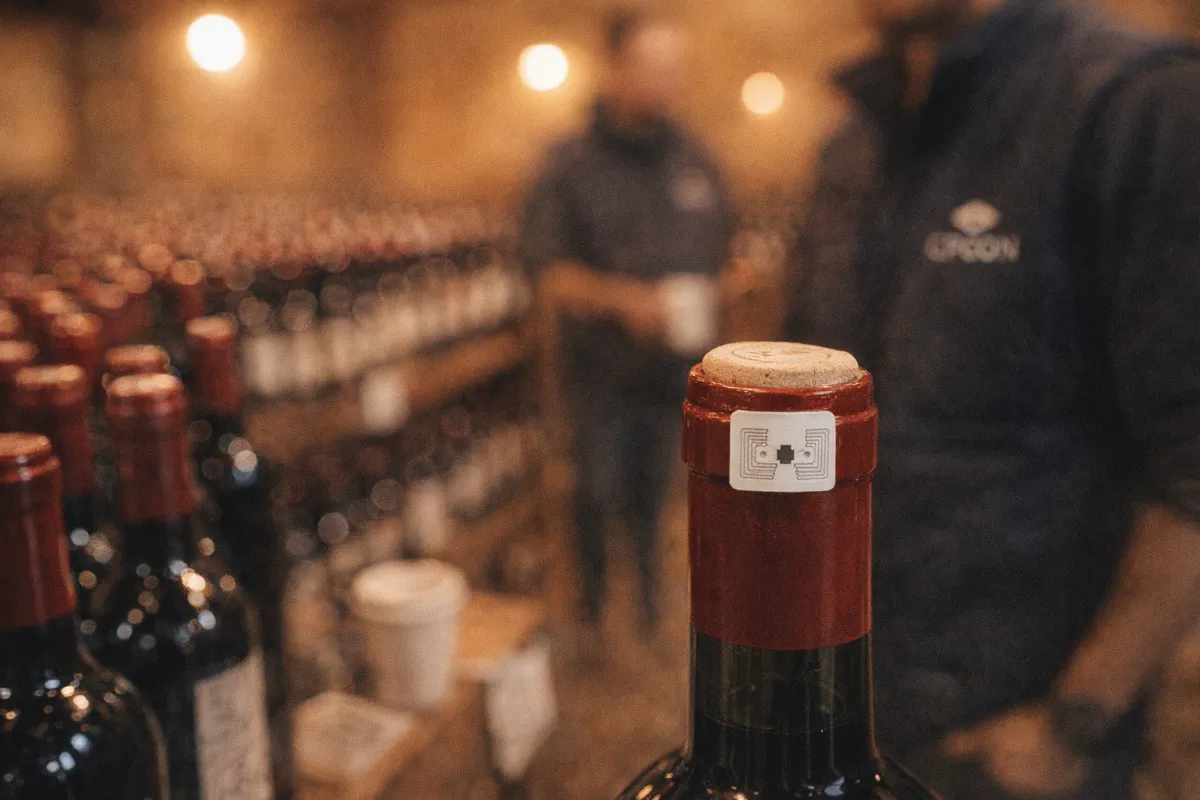
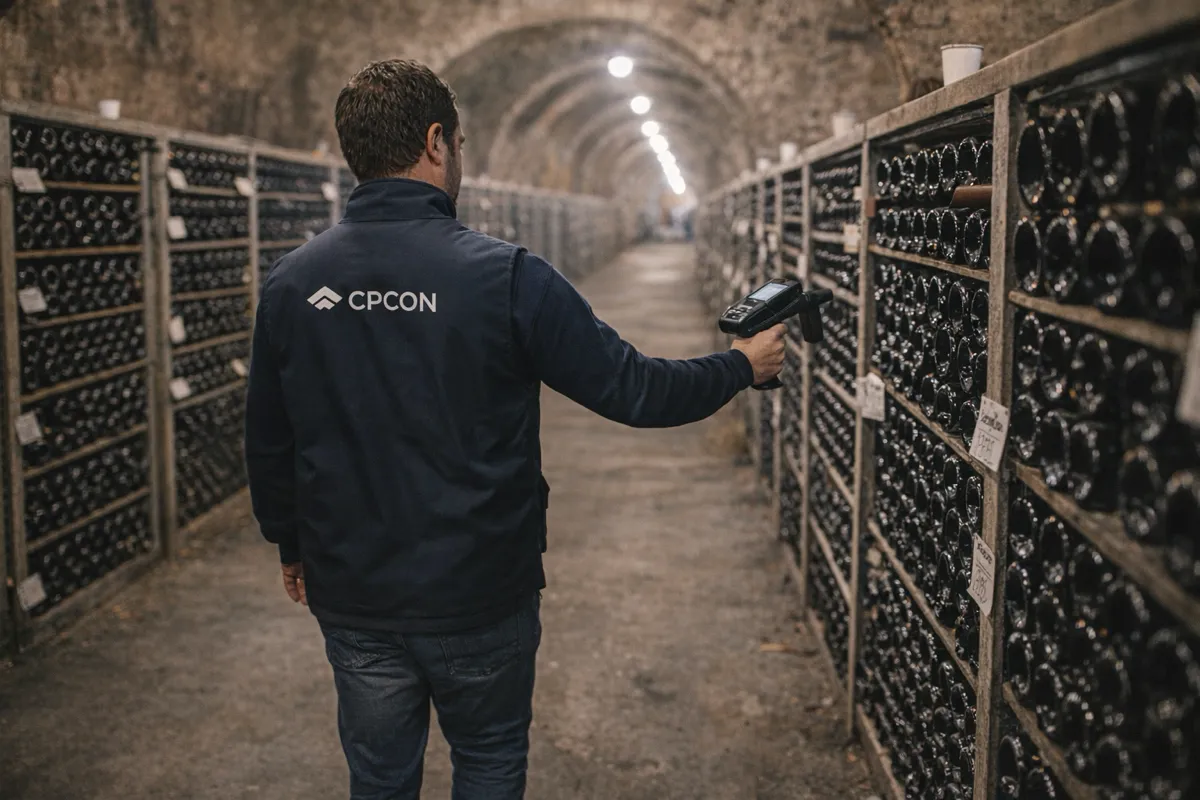
RFID closes the verification gap. By tagging bottles, cases or both, an operator reads hundreds of tags per second without line-of-sight, so a full cellar that once took days is counted in minutes — every bottle uniquely identified. RFID is not the cheapest option and is not always necessary for very small cellars, but for large, high-value or compliance-heavy operations it delivers count speed and traceability the other approaches cannot. CPCON's RFID wine inventory tracking platform pairs this scanning speed with ERP reconciliation and a full lifecycle workflow. For the mechanics, see how RFID wine bottle tracking works.
Manual vs barcode vs RFID: a side-by-side
The clearest way to choose is to compare the count itself. This table sets manual and spreadsheet methods against barcode and RFID across the metrics that actually drive cost and risk.
| Capability | Manual / Spreadsheet | Barcode | RFID |
|---|---|---|---|
| Count speed | Days for a full cellar | Hours; one scan per item | Minutes; hundreds of tags/sec |
| Accuracy | Low; human error | High on scanned items | Very high; automated capture |
| Traceability granularity | Lot at best | Item / case | Bottle-level, unique ID |
| ERP reconciliation | Manual re-keying | Semi-automated | Automated, event-level |
| Labor required | High | Moderate | Low |
Note that line-of-sight scanning and bulk reads sit on the same continuum as broader RFID tracking used in asset and warehouse contexts — wine simply adds traceability and tax requirements on top.
Matching the approach to your operation
The comparison above is not an argument that everyone needs RFID. It is an argument for matching the tool to the operation. Three variables decide the answer: how many bottles you hold, how much they are worth, and how heavy your compliance burden is. Read those honestly before you read any vendor pitch.
Small producer, single location
If you hold a few thousand bottles in one room and ship modestly, a spreadsheet or an entry-level barcode system is a defensible choice. The cost of tagging and readers would outweigh the time you would save, and a careful manual count once or twice a year is manageable. The trigger to move up is not bottle count alone but pain: when counts start slipping, when staff dread stocktake week, or when a tax filing forces a number you cannot defend.
Growing winery or distributor
Once you cross into tens of thousands of bottles, multiple storage zones, or several SKUs moving in and out weekly, the manual ceiling becomes a wall. This is where barcode systems and dedicated winery software pay off as the system of record, but it is also where the verification gap starts to cost real money. Many operations at this stage run a capable winery ERP yet still cannot count their own cellar in under a day — a sign the record and the reality have quietly diverged.
High-value or compliance-heavy operation
For reserve cellars, imported allocations, or any operation answering to auditors and tax authorities, the calculus changes. The cost of a single unexplained discrepancy — in shrinkage, in a failed audit, in a recall that cannot be scoped — dwarfs the cost of tagging. Here bottle-level RFID stops being a luxury and becomes the control that makes the rest of the stack trustworthy.
Traceability and compliance: the part spreadsheets cannot fake
For wineries operating in Brazil and Latin America, compliance is not a nice-to-have feature bolted onto inventory — it is the inventory's reason for existing in the eyes of the tax authority. Every movement of wine generates fiscal consequences, and the records you keep have to survive scrutiny long after the bottle has shipped. This is where the difference between a record-keeping tool and a true wine inventory system becomes sharpest.
Concretely, that means correct NCM classification for wine (heading 22.04), the right CFOP on every inbound and outbound movement, and NFe documents that reconcile cleanly with what physically moved. It also means an audit log that no one can quietly edit after the fact, kept in line with LGPD data-protection obligations. A spreadsheet can hold these fields, but it cannot prove they were not changed, and it cannot tie a fiscal document to a specific, uniquely identified bottle. Bottle-level tracking can — which is precisely why traceability and compliance, not raw speed, are often the deciding factors for serious buyers.
Buyer's checklist: what to look for
Whichever approach you favor, evaluate vendors against the capabilities that separate a record-keeping tool from a true wine inventory system. The following checklist reflects what Brazilian and Latin American operations in particular need to satisfy finance and the tax authority.
Capabilities that matter
- Bottle-level traceability: Unique IDs, not just lot or case totals, so any bottle can be located and its history retrieved.
- ERP / SAP / TOTVS reconciliation: Verified counts flow back into the general ledger without manual re-keying or spreadsheet bridges.
- NFe and tax-code handling: Native support for Brazilian fiscal documents, NCM 22.04 classification and correct CFOP on movements.
- Immutable, LGPD-compliant audit log: A tamper-evident record of every count and movement that stands up to audit while respecting data-protection rules.
- Print-on-demand label templates: Generate cork, counter-label and box tags on demand to match the bottle and packaging format.
- Lifecycle workflow: Defined states from tagging through storage, movement and dispatch, so status is always explicit, not inferred.
Where CPCON fits
CPCON's approach is end-to-end RFID wine inventory tracking built for operations that have outgrown manual and barcode counts. The platform tags bottles in the formats wineries actually use — cork tags, counter-labels and box tags — and tracks each one through a six-state lifecycle from initial tagging to final dispatch. Because every bottle carries a unique ID, a full cellar count takes minutes rather than days, and the result is a verified figure, not an estimate.
Just as important, those counts do not stay trapped in a scanning app. CPCON reconciles verified, event-level data back into ERPs such as SAP and TOTVS, handles Brazilian NFe and tax-code requirements, and maintains an immutable audit log. The aim is not to replace your production system but to give it the accurate physical count it has always lacked — closing the gap between the number in the ledger and the bottles on the shelf.
If your cellar has grown past the point where hand counts are credible, the fastest way to evaluate the fit is to see the workflow end to end. Explore the RFID wine inventory tracking platform to map your formats, lifecycle states and ERP reconciliation against what your buyer's checklist demands.