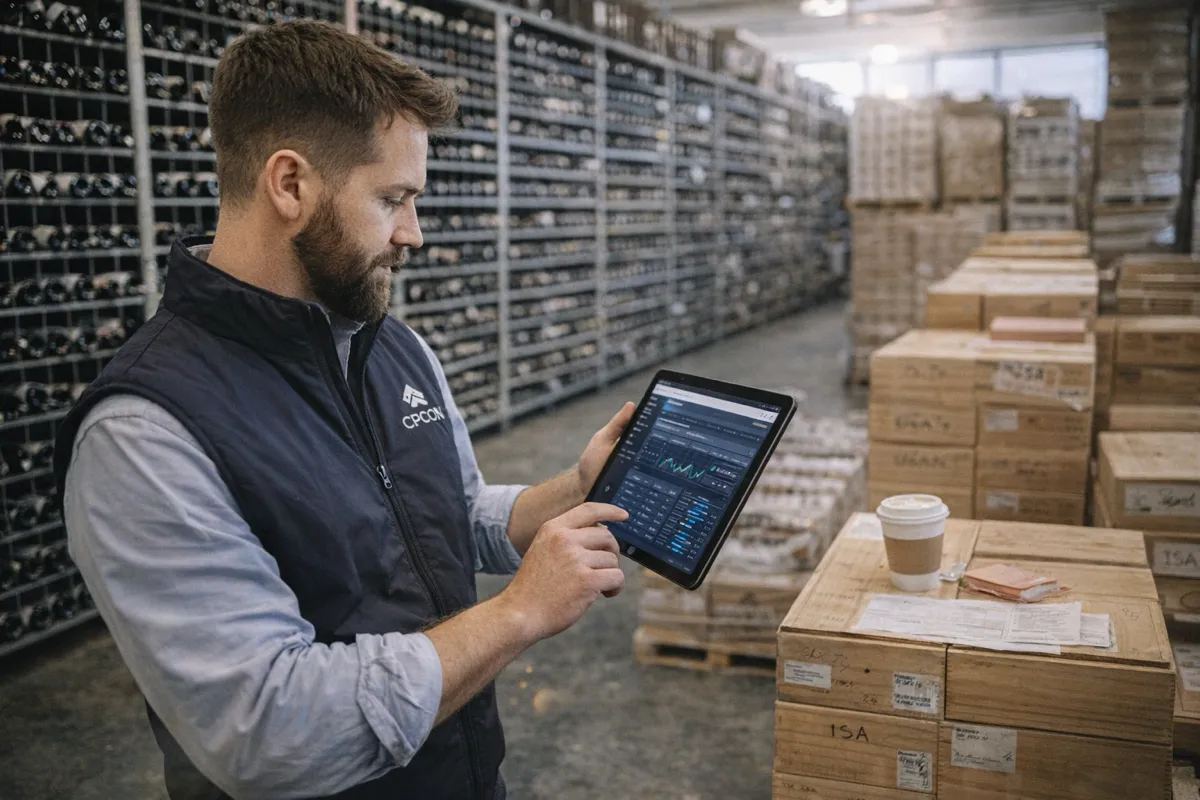
How RFID Wine Bottle Tracking Works — From Cork to Case
RFID wine bottle tracking gives wineries, importers and cellars a unique digital identity for every bottle — readable through glass and liquid, countable by the hundred, and traceable from the bottling line to the customer's hand.
Rafael Dias
President/CEO MX, CDMX
Rafael leads CPCON's operations in Mexico and Latin America, specializing in RFID technology implementation and inventory traceability solutions. His expertise helps wineries and importers modernize how they track, audit and protect high-value bottled stock.
How does RFID wine bottle tracking work?
A tiny UHF RFID tag on the cork or capsule gives each bottle a unique digital ID. Handheld or dock readers capture that ID through the glass and liquid — hundreds per second, with no line of sight — recording every move from bottling to delivery.
Wine inventory is uniquely unforgiving. A single bottle can be worth more than an entire pallet of ordinary stock, vintages and lots must never be mixed up, and the product sits in dim cellars, stacked cases and crowded racks where it is hard to see, let alone count. Barcodes and manual logs were never built for this. They need line of sight, one scan at a time, with someone physically turning each bottle to find the label — slow, error-prone, and impossible to do without unpacking cases. RFID wine bottle tracking removes those limits by turning every bottle into a uniquely identified, machine-readable object.
What RFID wine bottle tracking actually is
RFID (Radio Frequency Identification) replaces the printed barcode with a tiny tag that contains a chip and an antenna. Each tag carries a unique EPC (Electronic Product Code) — effectively a serial number for that one bottle. Instead of pointing a scanner at a visible barcode, an RFID reader emits a radio field and every tag inside that field answers back at once. The result is bottle-level traceability: you no longer count "a case of Cabernet," you account for each individual bottle by its own identity, wherever it physically sits.
This is the foundation of CPCON's RFID wine inventory tracking platform, which is purpose-built for the materials and movements of the wine trade rather than adapted from generic warehouse tagging.
The three tag formats: cork, counter-label and case
One tag style cannot cover a glass bottle, a paper back-label and a cardboard case. The platform uses three complementary formats, each tuned to where it lives:
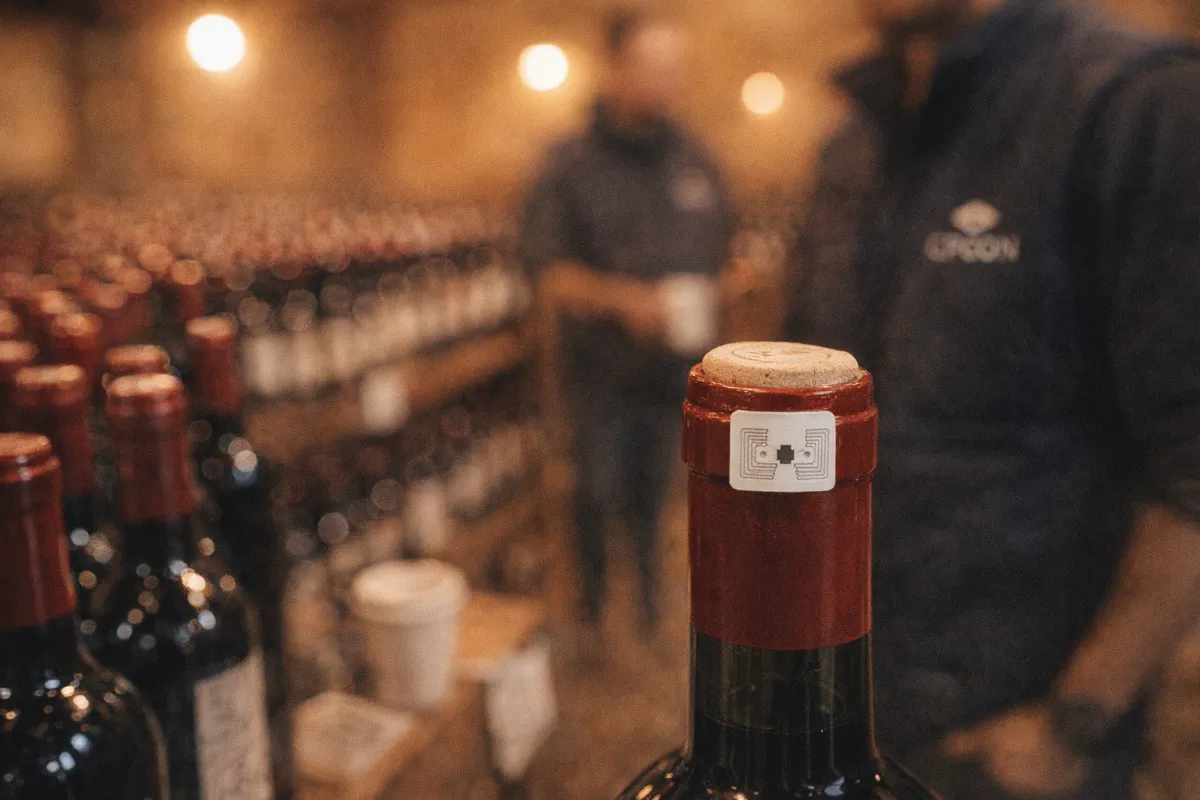
- Cork 14×14 mm UHF EPC tag: a small non-metal, low-power inlay applied to the cork face or capsule. It is tuned to read reliably through glass and liquid, carrying the bottle's unique EPC identity.
- Counter-label 80×40 mm (EPC + QR): placed on the back of the bottle, it pairs the RFID EPC with a human- and phone-readable QR code holding lot, vintage and ABV — useful for staff, auditors and customers without a reader.
- Box 120×80 mm case tag: groups a six-bottle case under one tag, so a sealed case can be moved, received and shipped as a single unit while still rolling up to its individual bottles.
Together these three layers let the system read at whatever granularity a moment requires — a whole case on a forklift, or one specific bottle pulled for a tasting.
How UHF RFID reads bottles
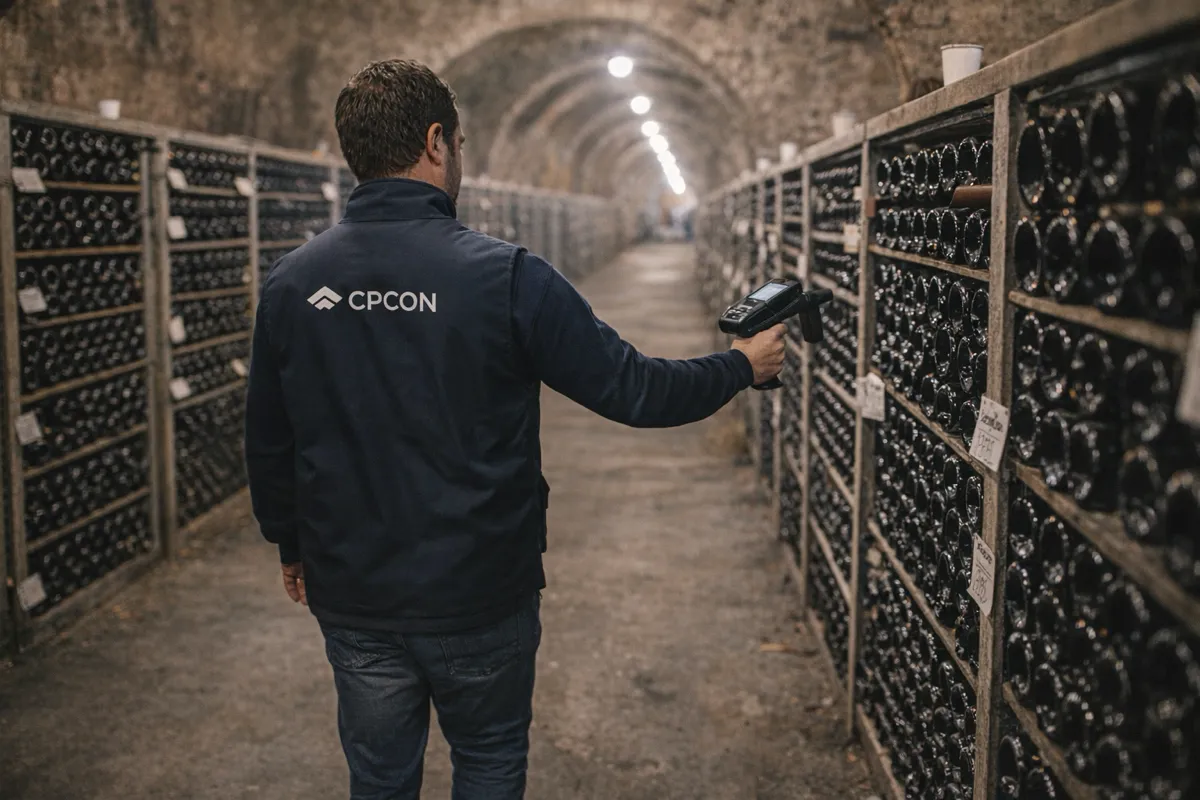
UHF RFID is what makes the speed possible. A single reader can capture hundreds of tags per second with no line of sight, reading straight through cardboard cases, wooden crates and stacked racks — even from across an aisle. There are two common ways to read:
Handheld readers
A Chainway-class handheld reader lets staff sweep a rack, a shelf or a pallet and capture every bottle in seconds. This is how a full wine cellar stocktaking drops from days of manual counting to a short walk-through — without opening a single case.
Dock portals
Fixed reader portals at a dock or doorway read cases automatically as they pass through. Expedition and receiving become a side effect of normal movement: roll a pallet through the portal and every bottle on it is logged, no extra scanning step required.
Does the tag affect the wine or the seal?
This is the first question every winemaker asks, and the answer is no. The cork tag is applied to the visible cork face or to the outside of the capsule. It never touches the wine, never enters the bottle, and never pierces or breaks the closure. Aging, oxygen exchange and bottle integrity all continue exactly as intended — the tag simply rides along on the outside, adding identity without altering the product.
The six-state bottle lifecycle
Identity only matters if the system knows what is happening to each bottle over time. The platform models every bottle through six lifecycle states, and each transition is recorded as an immutable, attributed audit event — who did it, when, and where:
- Produced — the bottle's EPC identity is created.
- Bottled — wine, lot and vintage are bound to that identity.
- Stored — the bottle enters the cellar or warehouse and is countable in stock.
- Expedited — it is picked and shipped out, typically read at a dock portal.
- Handed — it is delivered or handed to a specific customer or channel.
- Consumed — the bottle reaches its final state and leaves active inventory.
Because every event is immutable and attributed, the lifecycle doubles as a chain of custody — you can replay exactly how a given bottle moved from the bottling line to the customer it was handed to, which is the heart of true bottle-level traceability.
Brazil fiscal and system fit
For operators in Brazil, the platform aligns bottle data with fiscal reality. It maps to the wine NCM classification (22.04), carries the correct CFOP on movements, and can drive NFe issuance at the moment of expedition. Bottle and stock events sync with SAP or TOTVS so inventory, finance and tax stay in step, and the attributed audit log is kept in an LGPD-compliant manner. The same RFID identity that powers cellar counts also feeds the fiscal record — one source of truth instead of two reconciled systems.
Where bottle tracking fits in the bigger picture
Bottle-level RFID is one layer of a broader stack. It feeds into purpose-built winery inventory management software for production, stock and sales workflows, and it shares the same UHF foundation used across CPCON's wider RFID tracking portfolio for assets and inventory. The difference for wine is the attention to closures, vintages and high unit value — details that generic tagging tends to miss.
Getting started
Moving from barcodes and spreadsheets to bottle-level RFID is mostly a matter of choosing the right tag formats for your packaging and deciding where to place readers — a handheld for the cellar, a portal at the dock, or both. CPCON's RFID wine inventory tracking platform handles the tags, readers, lifecycle logic and fiscal integration as one solution, so you get accurate counts, real chain of custody, and traceability from cork to case without rebuilding your operation. Contact CPCON to map RFID wine bottle tracking onto your cellar, warehouse or import flow.