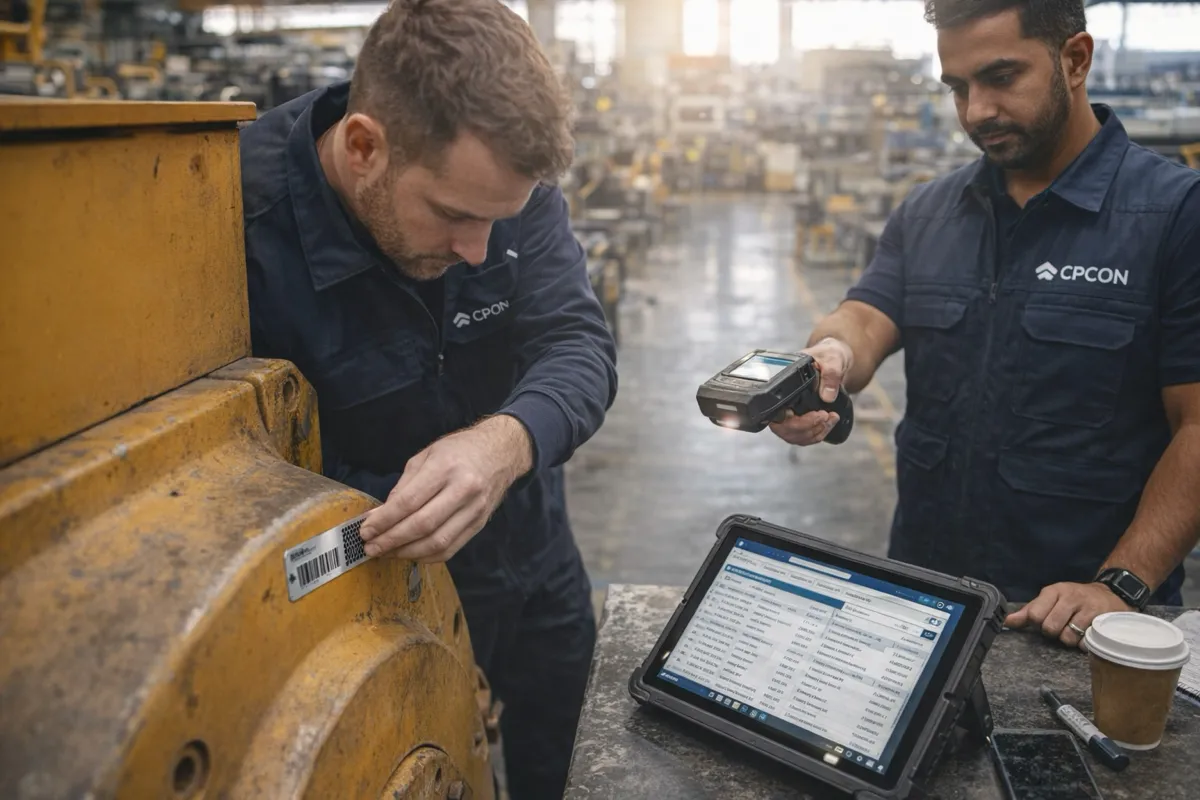
What a pooled asset is
Many plants hold large groups of small, similar items. Examples are moulds, tools, dies, benches, racks and office chairs. Each item costs little. Together, the group can have a large book value.
Many companies record such a group as one pool on the fixed asset register. The pool has one asset number, one cost and one depreciation line. The floor has hundreds of physical items.
This guide answers these questions. First, we show what the standards say. Then, we tell what a good pooled count must give the controller and the auditor.
What the standards say
IFRS: IAS 16 lets you aggregate small items. IAS 16 does not set the unit of measure for an item of property, plant and equipment. It says judgement is necessary. It also says "it may be appropriate to aggregate individually insignificant items, such as moulds, tools and dies, and to apply the criteria to the aggregate value" (IAS 16.9). [S1]
IFRS: significant parts get separate depreciation. IAS 16 requires an entity to depreciate separately each part with a cost that is significant to the total cost of the item (IAS 16.43). Parts with the same useful life and depreciation method can be grouped (IAS 16.45). [S1]
US GAAP: the unit of depreciation can be a group. ASC 360-10-35 (Subsequent Measurement) describes depreciation as the allocation of cost "over the estimated useful life of the unit (which may be a group of assets) in a systematic and rational manner." [S2]
PwC guide: group and composite methods need data. The PwC PP&E guide (section 4.3.3.5) says the group method fits assets that are "largely homogeneous" with about the same useful lives. The composite method fits closely related assets with different lives, "in limited circumstances." Both depreciate over the average life of the group. PwC says the entity "should have quantitative data to support the use of the method." It also says updated depreciation studies are usually done on a regular basis. [S3]
PwC guide: retirements usually go to accumulated depreciation. Under both methods, a normal retirement usually gives no gain or loss in earnings. The difference goes to accumulated depreciation. Unforeseen or unexpected retirements give a gain or loss in earnings. [S3] This matters for counts. A missing item in a pool may not show in the P&L. The count is often the only control that finds it.
PCAOB: existence is an assertion, and inspection includes physical examination. AS 1105.10 requires the auditor to test the accuracy and completeness of company data. AS 1105.11 lists "existence or occurrence" as an assertion: assets exist at a given date. AS 1105.15 says inspection includes "physically examining an asset." AS 1105.07 says relevance depends in part on "the level of disaggregation or detail of information." [S5]
Deloitte: composite is a US GAAP option, not an IFRS option. Deloitte's IFRS and US GAAP comparison says that under IFRS, "composite depreciation is not an acceptable method for depreciation." Under US GAAP, it says component depreciation "is not required but is considered acceptable." It also says composite depreciation is common in some industries, such as utilities and railroads. [S6]
KPMG: IFRS requires separate depreciation of significant parts. KPMG says that, unlike US GAAP, IFRS requires companies to depreciate significant parts separately. [S7] This agrees with IAS 16.43. [S1]
What this means for a count: the accounting framework changes the unit you must prove. Under IFRS, a pool of small items is acceptable through IAS 16.9. But a significant part needs its own line. Under US GAAP, a group or composite unit is acceptable when data supports it. In both cases, the count must show the items in the pool exist.
Existence testing in plain terms
Auditors test assertions. One assertion is existence. It means the assets on the books are real at a given date (AS 1105.11). [S5]
AS 1105 lists audit procedures. One is inspection. Inspection includes "physically examining an asset" (AS 1105.15). [S5] In plain words, someone goes to the floor and looks at the item.
AS 1105 also says how reliable evidence is. Evidence the auditor gets directly is more reliable than evidence the auditor gets indirectly (AS 1105.08). [S5] So a count file does not replace the auditor's own work. It gives the auditor a clean path to test.
AS 1105.22 gives three ways to select items to test: all items, specific items, or audit sampling. [S5] For a pool, the auditor may pick tags from the file and go to the floor. Or the auditor may pick items on the floor and trace them back to the file. A good return file supports both directions.
What the standard does not say: AS 1105 does not tell the company how to tag, count or file pooled items. Those choices are the company's.
What the standards do not say
- No standard we found tells you how to tag pooled items.
- No standard we found sets a quantity rule for a pool, a return-file format or a CMMS link rule.
- We did not find public IIA guidance on tagging pooled furniture or pooled assets.
- We did not find public Deloitte, KPMG or EY guidance on tagging pooled assets. Deloitte and KPMG pages cover depreciation units, not tags. We found no EY accounting page on group or composite depreciation.
The standards leave the method to the company. The sections below say what a good count of pooled assets must give the controller and the auditor. They are CPCON recommendations. They are not requirements of IAS 16, ASC 360 or PCAOB standards.
What a good pooled count gives you
- One link for each item. Each counted item links to one place: its own register line, a purchase lot, a pool, or a short hold list for the controller to decide.
- Found against expected. Each pool shows the found quantity next to the register quantity, with a short reason for each difference.
- A clear maintenance split. You can see which items need maintenance records and which do not.
- Evidence the auditor can trace. Tag IDs, locations and photos support each item.
How to link each item, what the return file holds and how to tag each item type are CPCON working methods. We agree them with you before the count.
Example: a pooled chair lot (example only)
This example is invented. It is not a client case. All numbers are examples.
A company records 120 task chairs as one register line under IAS 16.9. [S1] At the count, 113 chairs are found, and some are in a different building. The controller gets the found quantity, the variance of 7 and the new locations. Under a group method, a normal retirement usually goes to accumulated depreciation, not to earnings. [S3] The controller records the decision and updates the locations.
Linking the count to maintenance records
A CMMS (maintenance management system) tracks maintenance. The register tracks cost. They do not need the same unit. Items that get planned maintenance, and significant parts with their own life (IAS 16.43) [S1], usually need a CMMS record. Items with no maintenance, such as chairs and shelves, usually do not. We agree the rule with your maintenance and finance teams for each site.
What the controller should see before sign-off
- A written policy basis for each pool (IAS 16.9 aggregation or ASC 360-10-35 group unit). [S1][S2]
- Current support for group or composite pools. [S3]
- No open items on the hold list at close.
- Found and register quantities for each pool, with each variance explained. Unexpected losses are checked for gain or loss in earnings. [S3]
- A list of items found but not on the register, for review.
- Count totals that agree to the register (AS 1105.10), and evidence for existence (AS 1105.11, .15). [S5]
- A signed and dated sign-off.
Common errors
These are errors we look for at count time. They are CPCON observations, not findings from a standard.
- One tag for the whole pool. A single tag on one chair does not prove 120 chairs exist. Tag each item, or record a count per location.
- Pool with no quantity. The register shows a cost but no quantity. The counter cannot compare found to expected. Ask the controller for the expected quantity before the count.
- Significant parts inside a pool. A large machine part sits in a pool of small tools. IAS 16.43 requires separate depreciation for significant parts. [S1] Move it out of the pool.
- Mixed lives in a group pool. Group depreciation fits items with about the same lives. [S3] If lives differ a lot, the controller must review the method.
- Disposals with no record. Items go to scrap, and nobody updates the register. The pool looks complete on paper.
How CPCON helps
We count, tag and reconcile fixed assets at industrial sites. We bring the method: how to link each item, how to tag each item type, and what goes in the return file. See fixed asset inventory services and asset tagging services. If your plant cannot stop, see keep running count.
Tell us about your sites, and we send a written quote.
Sources
- [S1] IFRS Foundation, IAS 16 (paras 9, 43, 45): https://www.ifrs.org/content/dam/ifrs/publications/html-standards/english/2026/issued/ias16.html
- [S2] FASB ASC 360-10-35 (via PwC Viewpoint codification): https://viewpoint.pwc.com/dt/us/en/fasb/GAAP/Codification/Codification/Codification/Assets/Property_Plant_and_Equipment/Overall/360-10-35.html
- [S3] PwC PP&E guide 4.3.3.5 group and composite: https://viewpoint.pwc.com/dt/us/en/pwc/accounting_guides/property_plant_equip/property_plant_equip_US/chapter_4_depreciati_US/43_attribution_US.html
- [S5] PCAOB AS 1105 Audit Evidence: https://pcaobus.org/oversight/standards/auditing-standards/details/AS1105
- [S6] Deloitte DART, Roadmap: IFRS vs US GAAP comparison, 1.6 PP&E: https://dart.deloitte.com/USDART/home/publications/deloitte/additional-deloitte-guidance/roadmap-ifrs-us-gaap-comparison/chapter-1-assets/1-6-property-plant-equipment
- [S7] KPMG, Accounting for PP&E under the IFRS component approach: https://kpmg.com/us/en/articles/2022/accounting-for-ppe.html