RFID vs. Barcode for Production Tracking: A Comprehensive Comparison
An in-depth analysis of RFID and barcode technologies for WIP tracking, including performance comparison, cost analysis, and decision framework for manufacturers.
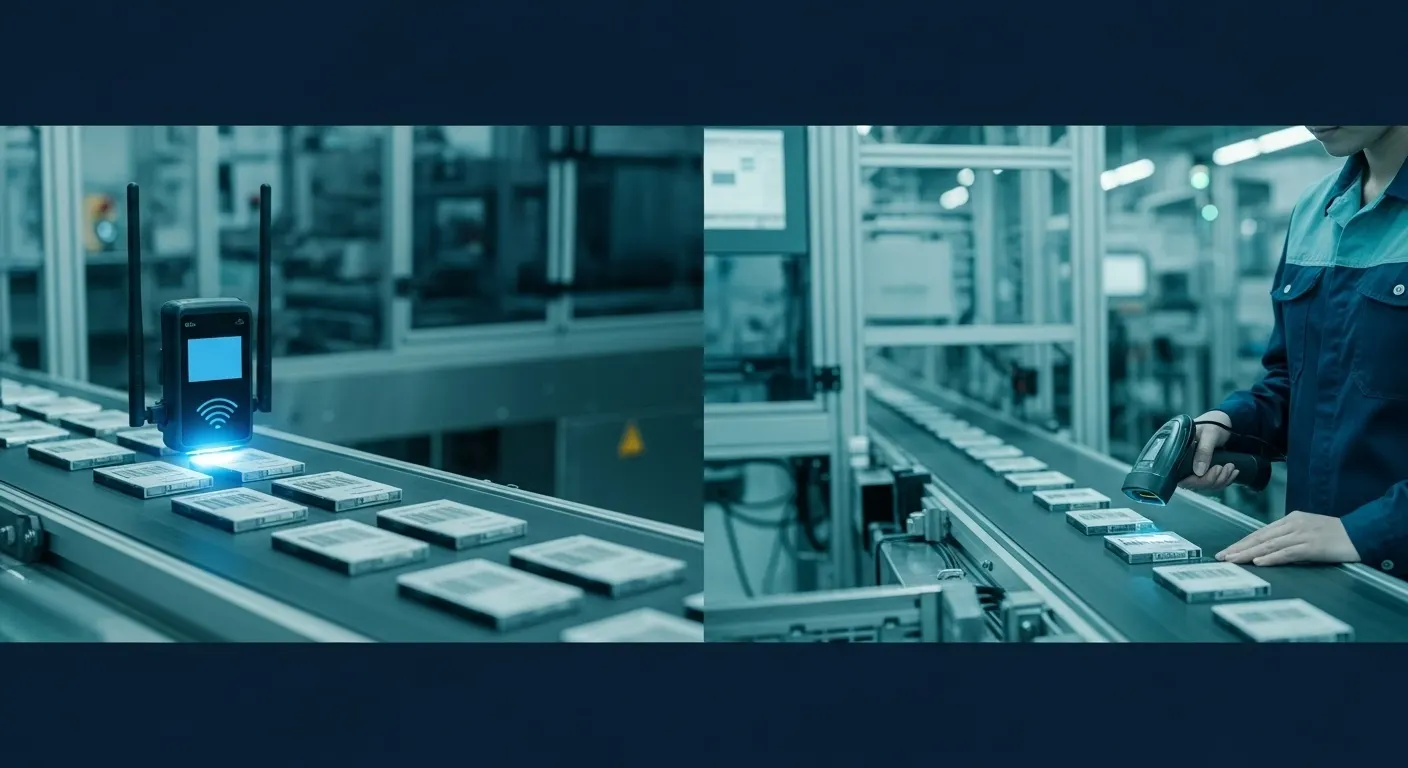
When implementing WIP tracking in manufacturing, one of the most critical decisions is choosing between RFID and barcode technology. Both have proven track records, but they differ significantly in capabilities, costs, and suitability for different applications. Making the wrong choice can result in wasted investment, operational inefficiencies, and missed opportunities.
This article provides a comprehensive comparison of RFID and barcode technologies for production tracking, helping you make an informed decision based on your specific requirements, constraints, and objectives.
Technology Overview
Barcode Technology
Barcodes encode data in visual patterns (1D or 2D) that are read optically using laser or camera-based scanners. The technology has been used in manufacturing for over 50 years and is mature, reliable, and well-understood.
RFID Technology
RFID uses radio waves to communicate between tags and readers. Tags contain a microchip and antenna that respond to reader signals, enabling automatic identification without line-of-sight or manual intervention.
Performance Comparison
| Capability | Barcode | RFID |
|---|---|---|
| Read Speed | 1-2 seconds per item | 200+ items per second |
| Read Range | Contact to 1 foot | Up to 40 feet (active RFID) |
| Line-of-Sight | Required | Not required |
| Bulk Reading | One at a time | Hundreds simultaneously |
| Data Capacity | Up to 7,089 characters (2D) | Up to 8KB (varies by tag) |
| Durability | Moderate (can fade/damage) | High (protected in tag) |
| Environmental Resistance | Low (affected by dirt, moisture) | High (works in harsh conditions) |
| Read/Write | Read-only | Read-write capable |
| Labor Requirement | Manual scanning required | Automatic (hands-free) |
| Accuracy | 99.9%+ (when scanned) | 99.9%+ (automatic) |
Key Insight:
RFID excels in speed, automation, and harsh environments, while barcodes offer simplicity and lower cost. The choice depends on your specific operational requirements and constraints.
Cost Analysis
Cost is often the deciding factor between RFID and barcode. Here's a detailed breakdown for a typical mid-sized manufacturing facility tracking 50,000 WIP items annually:
Barcode System Costs
Annual Operating Costs:
RFID System Costs
Annual Operating Costs:
5-Year Total Cost of Ownership
RFID premium: $93,000 over 5 years, but delivers $47,500/year in labor savings and enables capabilities impossible with barcodes.
Use Case Suitability
When Barcode is the Better Choice
- Low-volume operations: Tracking fewer than 10,000 items annually where manual scanning is manageable
- Controlled environments: Clean, dry conditions where labels won't degrade
- Sequential processing: Items move one at a time through defined checkpoints
- Budget constraints: Limited capital available for initial investment
- Simple tracking needs: Basic location and status tracking without real-time requirements
When RFID is the Better Choice
- High-volume operations: Tracking tens of thousands of items where manual scanning is impractical
- Harsh environments: Exposure to heat, moisture, chemicals, or abrasion that damages barcodes
- Bulk processing: Need to track multiple items simultaneously (pallets, containers, batches)
- No line-of-sight: Items are obscured, stacked, or inaccessible for scanning
- Real-time requirements: Need continuous, automatic tracking without manual intervention
- Data updates needed: Requirement to write data to tags during production (process parameters, test results)
The Hybrid Approach
Many manufacturers find that a hybrid approach—using both RFID and barcodes strategically—delivers the best overall value. This allows you to leverage the strengths of each technology where they're most beneficial.
Typical Hybrid Implementation
RFID for High-Volume Areas
Use RFID at receiving docks, between major production stages, and at shipping to automatically track bulk movements without slowing operations.
Barcode for Detailed Operations
Use barcodes at individual workstations where operators are already handling items and can easily scan for detailed process tracking.
Barcode for Quality Checkpoints
Use barcodes at inspection and test stations where deliberate scanning ensures quality data is captured with each item.
Hybrid Advantage:
A hybrid approach typically costs 20-30% less than pure RFID while delivering 70-80% of the benefits. It's often the most pragmatic choice for manufacturers with diverse tracking needs.
Decision Framework
Use this framework to evaluate which technology is right for your operation:
| Evaluation Criteria | Barcode | RFID |
|---|---|---|
| Annual tracking volume < 10,000 items | ||
| Annual tracking volume > 50,000 items | ||
| Clean, controlled environment | ||
| Harsh environment (heat, moisture, chemicals) | ||
| Items always accessible for scanning | ||
| Items obscured or inaccessible | ||
| Need to track individual items | ||
| Need to track bulk/pallets simultaneously | ||
| Budget < $150K | ||
| Real-time tracking required |
Conclusion
There is no universal "best" choice between RFID and barcode for production tracking—the right answer depends on your specific operational requirements, constraints, and objectives. Barcode technology offers simplicity, lower cost, and proven reliability for many applications. RFID provides automation, speed, and capabilities that are impossible with barcodes.
For many manufacturers, a hybrid approach that strategically deploys both technologies delivers the best overall value. This allows you to leverage the strengths of each technology where they provide the most benefit while managing costs effectively.
The key is to thoroughly evaluate your requirements, understand the capabilities and limitations of each technology, and make a decision based on data rather than assumptions. With the right technology choice and implementation approach, WIP tracking can deliver significant operational improvements and rapid ROI.
Need Help Choosing the Right Technology?
Our team has implemented hundreds of WIP tracking systems using both RFID and barcode technologies. We can help you evaluate your requirements and design the optimal solution for your operation.