If you operate in St. Peters, Missouri, business personal property tax is not a city spreadsheet exercise. The city’s finance page states that real estate and personal property taxes are collected by the county collector, and that the St. Charles County Assessor establishes assessed value. St. Peters also states publicly that personal property is assessed at 33 1/3 percent of book value.
That matters for ghost fixed assets: lines still on your fixed-asset register after the equipment left the floor. For the national mechanism, see personal property tax on ghost fixed assets. This flank is the St. Charles County filing loop only.
Local one-liner: On the St. Charles County form, previously reported equipment you did not own on January 1 has to be cleared — inventory and disposal tags are how you know which lines to line through.
St. Peters files through St. Charles County — not St. Louis County
St. Peters sits in St. Charles County. The city’s finance page is explicit: the county collector collects real estate and personal property tax, and the St. Charles County Assessor sets assessed value. Personal property is assessed at 33 1/3 percent of book value.
The form that carries that assessment is the county’s Business & Aircraft Personal Property Assessment Form — not a St. Louis County listing, and not a city worksheet. If your register, ERP plant code, or prior-year filing still points a St. Peters site at St. Louis County, you are feeding the wrong roll.
The St. Charles County Assessor’s public pages confirm personal property is reassessed each year and that business personal property assessment forms are due March 1. The operational question for a St. Peters plant is therefore simple: which register lines were still owned, or under your charge or management, on January 1 at a St. Charles County situs?
Existence — prove Jan 1 ownership on the floor
County instructions citing RSMo 137.115 require a return of all tangible personal property you owned or had under your charge, care, or management on January 1 — used in the business and not held for resale. That includes assets of any age, even if fully depreciated under IRS rules or expensed.
Fully depreciated is not an automatic off-ramp from the St. Charles County schedule. A press that still sits on the floor on January 1 remains reportable. A press that left last year but still sits on the register is a ghost asset: the assessor sees the list, not the empty bay.
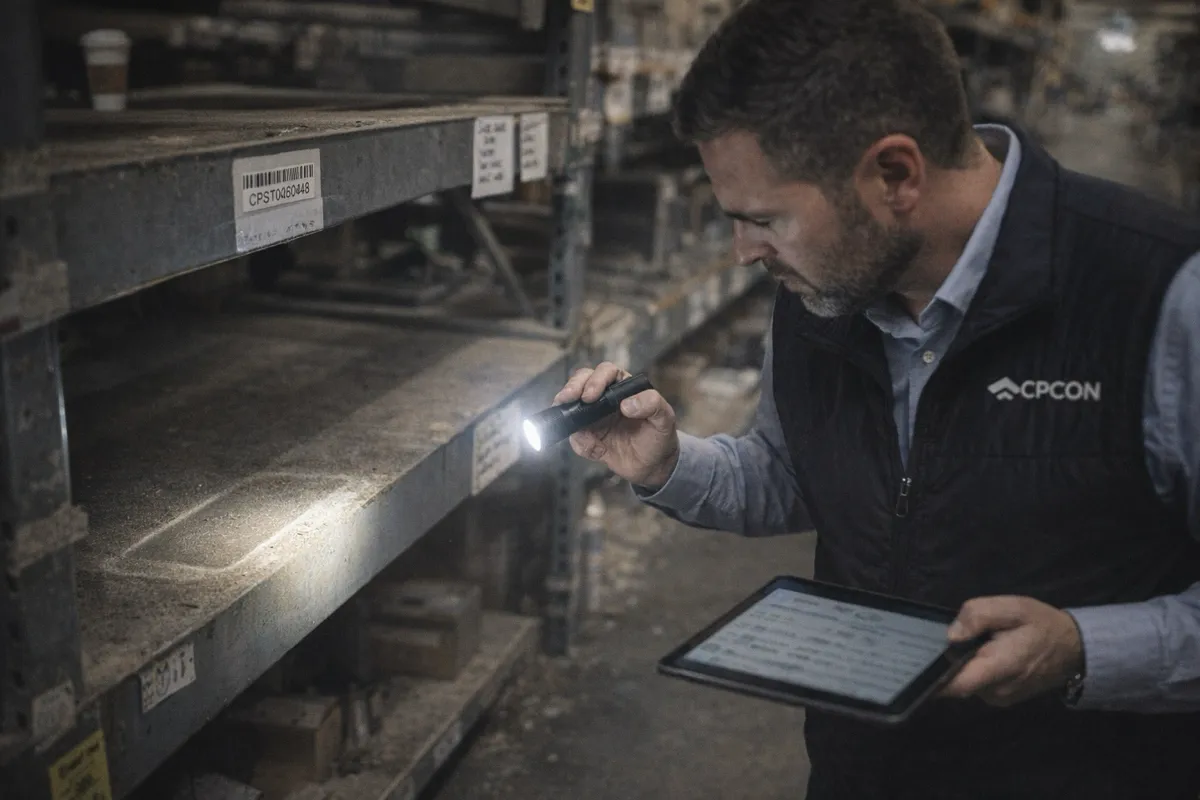
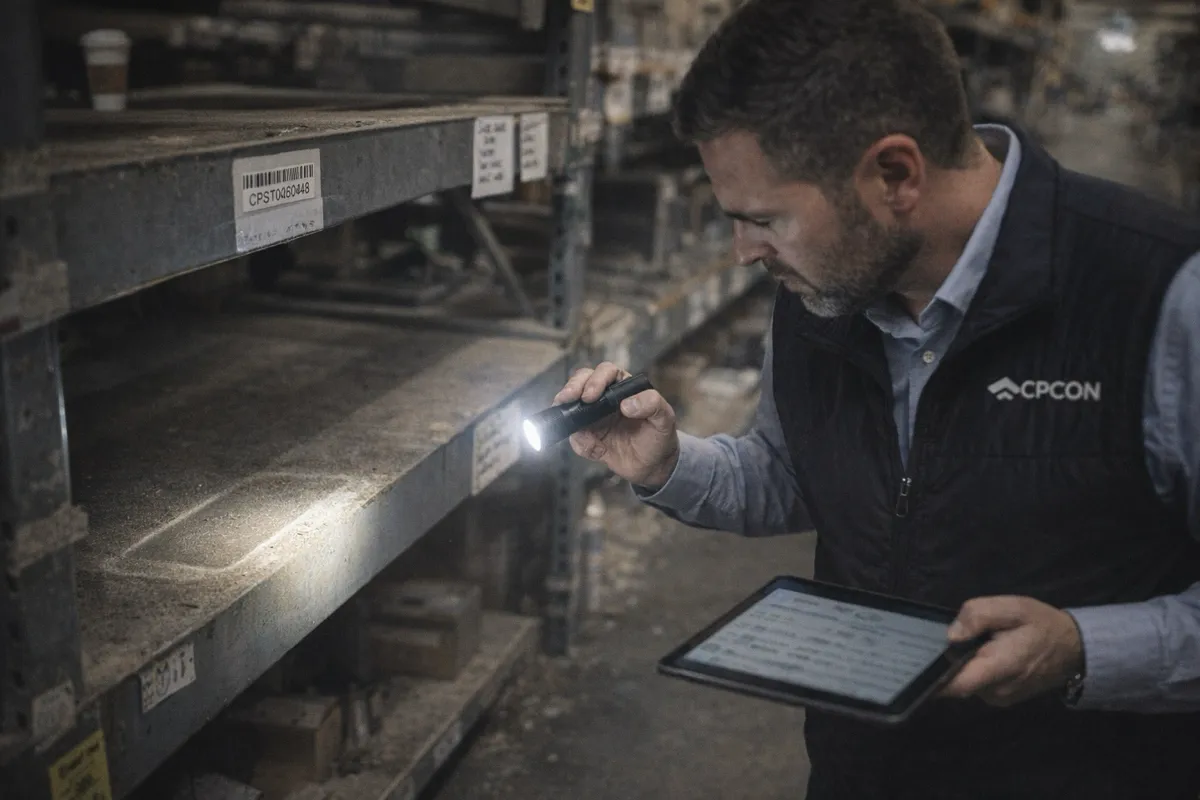
Physical fixed-asset inventory (file-to-floor and floor-to-file as needed) answers the filing question: which register lines still exist as tangible personal property at the St. Peters site on January 1?
- Lines that fail a disciplined search become disposal / ghost candidates — the lines you will mark on Block 1, not silent keepers on the pre-printed schedule
- Untagged or unverified populations are the highest-risk keepers: the county cannot see your floor
- Durable tags (barcode / RFID / permanent ID) tie a physical unit to a register ID so the next count and the next March 1 return are reconcilable — see our asset tagging guide
Existence evidence is what lets tax and finance support a “not owned on January 1” line-through on the county form. Without it, the pre-printed cost stays.
Location — keep situs on the right county roll
The St. Charles County form asks you to verify the location address. If it is wrong, you draw a line through it and write the correct location. That is a situs control, not a mailing-label cleanup.
Wrong location fields on the register create two cash risks for a St. Peters operator:
- Filing into the wrong county roll — including a St. Louis County return for equipment that sits in St. Peters
- Duplicate exposure when a St. Charles County site still carries equipment that physically moved, or a closed St. Peters location still prints on last year’s form
Tagging programs that update location / cost center / plant as part of the count keep situs on the St. Charles County roll that actually covers the floor. The location on the tag and in the register must match the plant the assessor cares about.
Disposal — line through ghosts before March 1
Block 1 on the St. Charles County form asks whether you disposed of any equipment during the previous year. County instructions are specific:
- Circle yes or no on the disposal question
- If yes, draw a line through the entire line of equipment disposed of during the previous year
- If only part of a line left, write the corrected cost in the Your Revised Cost column
- Draw a line through any previously reported pre-printed item you did not own on January 1
The form’s own note: any pre-printed item not lined through will be assessed. That is the ghost-asset cash leak in county language. A journal entry that never reaches Block 1 leaves last year’s cost on the roll.
Accounting write-offs and retirement entries still matter for the books — see our asset write-off and retirement guide — but St. Charles County relief requires those retirements to show up as line-throughs (or revised cost) on the next assessment form.
RSMo 137.345 provides for a penalty if the assessment form is not returned by the first day of March. The county form repeats that instruction on its face: Avoid Late Penalty — Return By March 1. Inventory and disposal tags have to be closed in time to support those line-throughs — not after the collector’s October statement arrives.
Tax roll — what the cleaned register feeds
The deliverable that stops the cash leak is not a spreadsheet of “proposed ghosts.” It is a filing package built from a cleaned register and entered on the St. Charles County form:
- Population owned or under your charge or management on January 1
- Correct St. Charles County location / situs
- Acquisitions added in Block 2 (new or used equipment placed in service last year)
- Disposals lined through on Block 1 with enough identity (description, year, cost) for the pre-printed schedule
County instructions also state there is a minimum assessed value of $100 on any business account. Combined with the city’s published 33 1/3 percent of book value assessment rate, the register that still carries disposed equipment is the list the Assessor will value.
CPCON’s role is operational evidence for your tax and filing team — independent fixed-asset inventory, tagging, and register reconciliation. CPCON is not your tax counsel and does not file St. Charles County returns on your behalf. Final positions belong to your finance leadership and advisors.
Explore fixed asset inventory and reconciliation when you want a register-to-floor assessment before the March 1 return.
Sources: City of St. Peters Finance; St. Charles County Assessor; Business & Aircraft Personal Property Assessment Form.
Frequently asked questions
Does a St. Peters business file personal property tax with St. Louis County?
No. St. Peters is in St. Charles County. The city’s finance page states that real estate and personal property taxes are collected by the county collector, and that the St. Charles County Assessor establishes assessed value. The filing loop is the St. Charles County Business & Aircraft Personal Property Assessment Form — not a St. Louis County return.
If we fully depreciated or expensed the equipment, is it off the St. Charles County return?
Not automatically. County instructions citing RSMo 137.115 state that reportable business personal property includes assets of any age, even if fully depreciated under IRS rules or expensed, when used in the business and not held for resale. Fully depreciated is not an off-ramp from the county schedule.
How do we clear ghost assets on the St. Charles County form before March 1?
On Block 1, mark whether you disposed of equipment during the previous year. Draw a line through previously reported items you did not own on January 1. The form states that any pre-printed item not lined through will be assessed. Fixed-asset inventory and disposal tags are how you know which lines to line through before the March 1 return (RSMo 137.345).
Can CPCON file our St. Charles County business personal property return?
No. CPCON provides fixed-asset inventory, tagging, and register reconciliation evidence. Your finance team and tax advisors own the St. Charles County filing.