RFID Portal for Health in Hospital Management: A Complete Implementation Guide
RFID portal systems are transforming hospital operations by enabling automated tracking of assets, patients, staff, and inventory. This comprehensive guide explores how healthcare facilities can leverage RFID portal technology to improve efficiency, reduce costs, and enhance patient care.
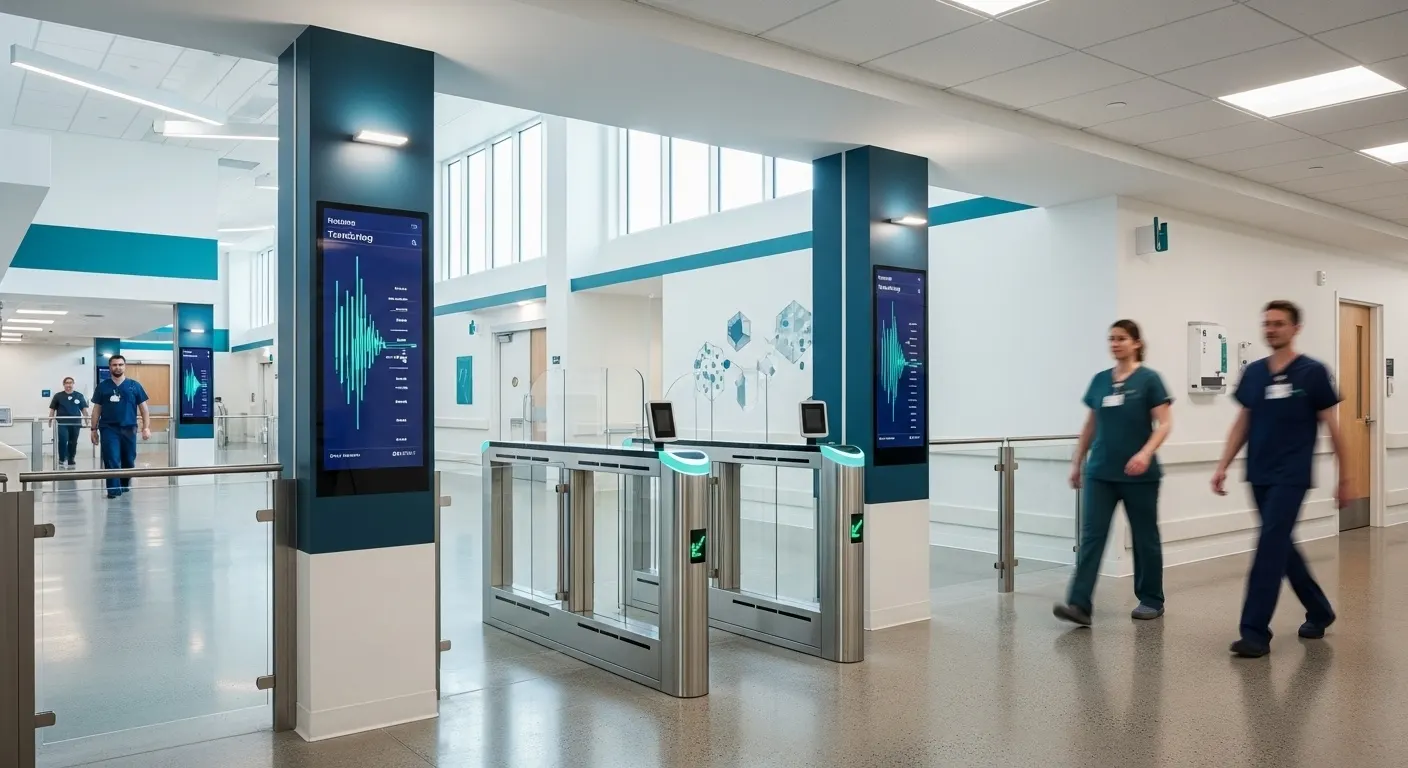
What is an RFID Portal System in Healthcare?
An RFID (Radio Frequency Identification) portal is a fixed infrastructure installation that automatically reads RFID tags as they pass through a designated area. In hospital settings, these portals are strategically placed at doorways, corridors, loading docks, and department entrances to capture real-time movement data without requiring manual scanning or line-of-sight contact.
Unlike handheld RFID readers that require staff intervention, portal systems operate autonomously 24/7, creating a continuous stream of location and movement data. This automation is particularly valuable in healthcare environments where staff time is precious and tracking accuracy is critical for patient safety and operational efficiency.
Key Statistics: RFID in Healthcare
- 30-40% of nursing time is spent searching for equipment in hospitals without tracking systems
- $4,000-$8,000 average cost per lost or stolen medical device annually
- 10-20% of mobile medical equipment is typically unaccounted for at any given time
- 85% reduction in equipment search time with RFID portal implementation
- 15-25% improvement in asset utilization rates post-implementation
Components of Hospital RFID Portal Systems
1. Portal Hardware Infrastructure
RFID Antennas:
- Doorway-mounted antennas: Installed on door frames to capture tags passing through
- Ceiling-mounted antennas: Provide overhead coverage for wider corridors
- Floor-embedded antennas: Used in high-traffic areas where wall mounting is impractical
- Typical configuration: 2-4 antennas per portal depending on doorway width
- Read range: 3-10 feet depending on antenna type and tag specifications
RFID Readers:
- Fixed readers: Permanently installed units connected to multiple antennas
- Network connectivity: Ethernet, Wi-Fi, or cellular for data transmission
- Processing power: On-board filtering and event processing capabilities
- Environmental rating: IP65 or higher for clinical environments
Supporting Infrastructure:
- Power over Ethernet (PoE): Simplifies installation and reduces cabling
- Network switches: Dedicated VLAN for RFID traffic recommended
- Edge computing devices: Local processing to reduce network load
- Backup power: UPS systems for continuous operation during outages
2. RFID Tags for Healthcare Applications
Asset Tags:
- Hard tags: Durable plastic housings for high-value equipment (IV pumps, monitors, ventilators)
- Metal-mount tags: Specialized tags designed to work on metallic surfaces
- Autoclave-safe tags: Withstand sterilization cycles for surgical instruments
- Flexible tags: Adhesive labels for smaller devices and consumables
- Cost range: $2-25 per tag depending on durability and features
Patient & Staff Tags:
- Wristband tags: Disposable or reusable bands for patient identification
- Badge tags: Integrated into staff ID badges for access and tracking
- Infant tags: Specialized secure tags for newborn tracking and security
- Visitor tags: Temporary tags for controlled access areas
Specimen & Supply Tags:
- Lab specimen tags: Track samples through collection, transport, and processing
- Blood product tags: Temperature-sensitive tags for cold chain compliance
- Pharmaceutical tags: Track controlled substances and high-value medications
- Supply chain tags: Bulk tracking of medical supplies and consumables
3. Software Platform
Core Functionality:
- Real-time location display: Visual maps showing asset and personnel locations
- Movement history: Complete audit trail of all tracked items
- Alert management: Configurable notifications for specific events
- Search functionality: Instant lookup of any tagged item
- Reporting & analytics: Utilization reports, movement patterns, dwell times
Integration Capabilities:
- EMR/EHR systems: Epic, Cerner, Meditech integration for clinical workflows
- CMMS: Computerized maintenance management for equipment service
- Nurse call systems: Automated equipment delivery requests
- Access control: Integration with door locks and security systems
- ERP systems: SAP, Oracle for financial and inventory management
Hospital Applications for RFID Portals
Medical Equipment Tracking
Challenge: Hospitals manage thousands of mobile medical devices that constantly move between departments, patient rooms, and storage areas. Without tracking, staff spend excessive time searching for equipment, leading to delayed patient care and unnecessary capital expenditures on duplicate equipment.
RFID Portal Solution:
- Portals at department entrances automatically log equipment movement
- Real-time visibility shows current location of all tagged devices
- Alerts notify staff when equipment leaves designated areas
- Utilization data identifies underused equipment for redeployment
- Maintenance triggers based on usage cycles or location events
Typical Equipment Tracked:
- IV pumps and infusion devices
- Patient monitors and telemetry units
- Ventilators and respiratory equipment
- Wheelchairs and transport equipment
- Portable imaging devices (ultrasound, X-ray)
- Defibrillators and crash carts
Results: Hospitals implementing RFID portal tracking for medical equipment typically achieve 70-85% reduction in search time, 15-25% improvement in equipment utilization, and 20-30% reduction in rental equipment costs.
Patient Flow Management
Challenge: Understanding patient flow through the hospital is essential for capacity planning, wait time reduction, and resource allocation. Manual tracking methods are labor-intensive and provide incomplete data.
RFID Portal Solution:
- Patient wristbands with RFID tags track movement through care areas
- Portals at department entrances capture arrival and departure times
- Real-time dashboards show patient locations and wait times
- Historical data reveals bottlenecks and process inefficiencies
- Automated alerts for patients waiting beyond threshold times
Key Applications:
- Emergency Department: Track patient progression from triage through discharge
- Surgical Services: Monitor patient flow through pre-op, OR, and recovery
- Radiology: Manage patient queues and room utilization
- Outpatient Clinics: Reduce wait times and improve scheduling accuracy
Results: Healthcare facilities report 15-30% reduction in patient wait times, 20% improvement in throughput, and significant gains in patient satisfaction scores.
Infant Security (Mother-Baby Matching)
Challenge: Infant abduction, though rare, is a critical security concern for hospitals. Additionally, ensuring correct mother-baby matching is essential for patient safety.
RFID Portal Solution:
- Secure RFID tags attached to infant ankles immediately after birth
- Matching tags on mother wristbands for positive identification
- Portals at all exits from maternity unit trigger immediate lockdown if infant tag detected
- Alerts when infant moves without accompanying mother tag
- Complete audit trail of all infant movements
Security Features:
- Tamper-evident tags that alert if removal is attempted
- Integration with door locks for automatic lockdown
- CCTV integration for visual verification
- Escalating alert protocols to security and law enforcement
Results: RFID infant security systems have proven 100% effective in preventing abductions when properly implemented, while also eliminating baby mix-up incidents.
Surgical Instrument Tracking
Challenge: Surgical instruments must be tracked through use, decontamination, sterilization, and storage. Retained surgical instruments are a serious patient safety issue, and incomplete instrument sets delay procedures.
RFID Portal Solution:
- Individual instruments tagged with autoclave-safe RFID tags
- Portals at sterile processing department entrances/exits
- Automated tray verification before and after procedures
- Sterilization cycle tracking linked to specific instruments
- Usage-based maintenance and replacement scheduling
Workflow Integration:
- Pre-procedure: Verify complete instrument set before surgery begins
- Intra-operative: Count verification during and after procedure
- Post-procedure: Confirm all instruments returned to SPD
- Sterilization: Track instruments through decontamination and sterilization
- Storage: Locate specific instruments or trays instantly
Results: Hospitals report elimination of retained instrument incidents, 50% reduction in tray assembly time, and 30% improvement in instrument utilization.
Pharmaceutical & Supply Chain Management
Challenge: Hospitals must maintain accurate inventory of medications and supplies while ensuring regulatory compliance for controlled substances and temperature-sensitive products.
RFID Portal Solution:
- Portals at pharmacy entrances track medication movement
- Automated receiving verification at loading docks
- Real-time inventory visibility across all storage locations
- Expiration date tracking and automated alerts
- Chain of custody documentation for controlled substances
Compliance Benefits:
- DEA compliance: Complete audit trail for Schedule II-V medications
- FDA UDI: Automated capture of unique device identifiers
- Joint Commission: Documentation for medication management standards
- Cold chain: Temperature monitoring integration for biologics
Results: Healthcare facilities achieve 99%+ inventory accuracy, 40% reduction in stockouts, and significant time savings in regulatory compliance documentation.
Implementation Best Practices
Phase 1: Assessment & Planning (4-8 weeks)
Current State Analysis:
- Inventory all assets to be tracked and their current management methods
- Document pain points: search time, equipment availability, compliance gaps
- Map facility layout and identify optimal portal locations
- Assess existing IT infrastructure and integration requirements
- Calculate baseline metrics for ROI comparison
Requirements Definition:
- Define tracking accuracy requirements (room-level vs. zone-level)
- Identify critical integration points (EMR, CMMS, security systems)
- Establish alert and notification requirements
- Determine reporting and analytics needs
- Set measurable success criteria
Vendor Selection:
- Evaluate vendors with proven healthcare experience
- Request demonstrations and reference site visits
- Assess total cost of ownership including ongoing support
- Verify integration capabilities with existing systems
- Review security and HIPAA compliance certifications
Phase 2: Pilot Deployment (8-12 weeks)
Pilot Scope:
- Select 1-2 departments with high pain points and engaged leadership
- Install 5-10 portals covering key transition points
- Tag 500-1,000 assets for initial tracking
- Duration: 60-90 days for adequate evaluation
Installation Activities:
- Site survey and RF environment assessment
- Portal hardware installation and configuration
- Network integration and security configuration
- Software platform deployment and customization
- Asset tagging and database population
Training & Change Management:
- Train pilot users on system functionality
- Establish super-user network for peer support
- Communicate benefits and expectations clearly
- Collect feedback and address concerns promptly
Success Metrics:
- System accuracy: 95%+ read rate at portals
- User adoption: 80%+ of pilot participants actively using system
- Measurable improvement in equipment availability or search time
- Positive user feedback and leadership support for expansion
Phase 3: Enterprise Rollout (6-18 months)
Rollout Strategy:
- Phased deployment by department, building, or asset category
- Prioritize high-value equipment and critical care areas
- Maintain pilot areas as reference sites for new users
- Typical timeline: 50-100 portals per quarter for large facilities
Scaling Considerations:
- Network capacity planning for increased data volume
- Server infrastructure scaling for larger asset databases
- Support team expansion for enterprise-wide coverage
- Integration expansion to additional systems
Ongoing Optimization:
- Regular system health monitoring and maintenance
- Quarterly business reviews with stakeholders
- Continuous improvement based on user feedback
- Expansion to new use cases and asset categories
ROI Analysis: Hospital RFID Portal Systems
Investment Costs (500-bed Hospital)
- Portal hardware: $150,000-300,000 (50-100 portals at $3,000-5,000 each)
- RFID tags: $100,000-200,000 (10,000-20,000 assets at $5-15 each)
- Software platform: $75,000-150,000 (license and implementation)
- Integration services: $50,000-100,000 (EMR, CMMS, security)
- Training & change management: $25,000-50,000
- Total initial investment: $400,000-800,000
- Annual operating costs: $75,000-150,000 (support, maintenance, tag replacement)
Quantifiable Benefits
- Labor savings: $200,000-400,000/year (reduced search time, automated tracking)
- Capital avoidance: $150,000-300,000/year (improved utilization, reduced hoarding)
- Rental reduction: $50,000-100,000/year (better visibility of owned equipment)
- Loss prevention: $75,000-150,000/year (reduced shrinkage and theft)
- Maintenance optimization: $50,000-100,000/year (usage-based scheduling)
- Total annual benefits: $525,000-1,050,000
ROI Summary
- Net annual benefit: $375,000-900,000 (after operating costs)
- Payback period: 12-24 months
- 3-year ROI: 150-300%
- 5-year NPV: $1.2M-2.8M (at 8% discount rate)
Case Study: Regional Medical Center RFID Implementation
Background
A 650-bed regional medical center with three campuses struggled with equipment management across its facilities. Nurses reported spending 30-45 minutes per shift searching for equipment, and the biomedical engineering department maintained 25% excess inventory to compensate for poor visibility.
Implementation
- Phase 1 (Months 1-4): Pilot in ICU and Emergency Department with 15 portals and 1,500 tagged assets
- Phase 2 (Months 5-10): Expansion to surgical services, imaging, and respiratory therapy
- Phase 3 (Months 11-18): Full deployment across all three campuses with 85 portals and 18,000 tagged assets
- Total investment: $1.2M including hardware, software, integration, and training
Results (24 Months Post-Implementation)
- 82% reduction in equipment search time (38 minutes to 7 minutes average)
- $1.8M capital avoidance through improved utilization and elimination of excess inventory
- 28% improvement in equipment utilization rates (34% to 62%)
- $320K annual savings from reduced equipment losses (shrinkage reduced from 7% to 1.5%)
- $180K annual savings from rental equipment reduction
- 94% staff satisfaction with equipment availability (up from 48%)
- Payback achieved: 14 months
Key Success Factors
- Strong executive sponsorship from CNO and COO
- Dedicated project manager with clinical and IT experience
- Comprehensive change management and training program
- Integration with existing EMR and CMMS systems
- Regular communication of metrics and success stories
Technology Considerations
RFID Frequency Selection
UHF RFID (860-960 MHz):
- Advantages: Longer read range (10-30 feet), faster read rates, lower tag costs
- Challenges: More susceptible to interference from liquids and metals
- Best for: Asset tracking, supply chain, general equipment management
- Typical portal configuration: 2-4 antennas per doorway
HF RFID (13.56 MHz):
- Advantages: Better performance near liquids, more precise read zones
- Challenges: Shorter read range (1-3 feet), slower read rates
- Best for: Patient wristbands, access control, close-proximity applications
- Typical portal configuration: Mat-style or doorframe antennas
Active RFID (433 MHz or 2.4 GHz):
- Advantages: Longest read range (100+ feet), real-time location capability
- Challenges: Higher tag costs ($15-40), battery replacement required
- Best for: High-value equipment, real-time location systems (RTLS)
- Typical configuration: Ceiling-mounted receivers throughout facility
Integration Architecture
Data Flow:
- Edge processing: Portal readers filter and aggregate raw tag reads
- Middleware: Translates RFID events into business events
- Application layer: RTLS platform processes location and movement data
- Integration layer: APIs connect to EMR, CMMS, and other systems
Security Considerations:
- Network segmentation: Dedicated VLAN for RFID traffic
- Encryption: TLS for all data transmission
- Access control: Role-based permissions for system access
- HIPAA compliance: PHI protection for patient tracking data
- Audit logging: Complete trail of all system activities
Future Trends in Hospital RFID
AI-Powered Analytics
Machine learning algorithms will analyze RFID data to predict equipment needs, optimize distribution, and identify workflow inefficiencies. Predictive models will anticipate maintenance requirements and suggest proactive interventions before equipment failures occur.
IoT Integration
RFID portals will integrate with IoT sensors to capture additional data points—temperature, humidity, vibration, usage cycles—creating comprehensive digital twins of hospital assets. This convergence enables condition-based maintenance and real-time performance monitoring.
5G-Enabled RFID
5G networks will enable real-time processing of massive RFID data streams, supporting more sophisticated location algorithms and instant alerts. Low-latency connectivity will enable new applications requiring immediate response, such as surgical instrument verification during procedures.
Blockchain for Healthcare Supply Chain
Blockchain technology combined with RFID will create immutable records of medical device and pharmaceutical provenance, enhancing traceability and combating counterfeiting. This integration will simplify regulatory compliance and enable automated smart contracts for supply chain transactions.
Conclusion
RFID portal systems represent a transformative technology for hospital management, enabling automated tracking of assets, patients, staff, and supplies with minimal manual intervention. The technology has matured significantly, with proven implementations demonstrating substantial ROI through labor savings, capital avoidance, and operational improvements.
Successful implementation requires careful planning, phased deployment, and strong change management. Healthcare facilities should start with focused pilot projects that demonstrate value before expanding to enterprise-wide deployment. Integration with existing clinical and operational systems is essential to maximize the value of RFID data.
As healthcare continues to face pressure to improve efficiency while maintaining quality, RFID portal technology will become increasingly essential. Facilities that invest in this infrastructure today position themselves to leverage emerging technologies—AI, IoT, 5G, blockchain—that will define the future of healthcare operations.
Related Articles
Medical Equipment Inventory Management
Best practices for tracking and managing medical equipment across healthcare facilities.
RFID: What It Is & How It Works
A comprehensive guide to RFID technology fundamentals and applications.
RFID vs BLE Tracking
Compare RFID and Bluetooth Low Energy technologies for asset tracking.
Healthcare Asset Tracking Solutions
Explore our comprehensive healthcare tracking solutions and case studies.