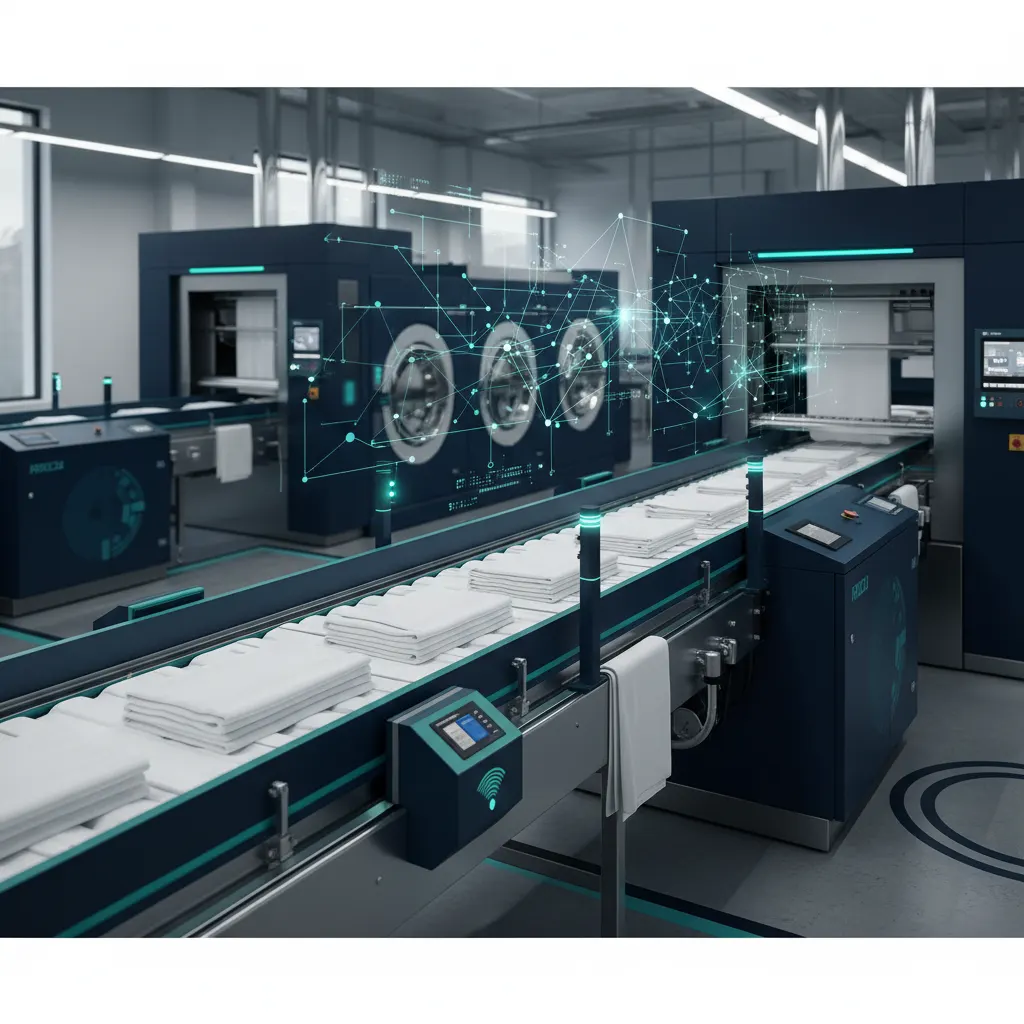
Laundry operations in hospitals, hotels, and industrial facilities process thousands of textile items daily -- yet most organizations still rely on manual counting, paper logs, and visual inspections to manage inventory. The result is predictable: lost linens, inaccurate stock levels, unnecessary replacement purchases, and labor-intensive audit processes. RFID laundry management eliminates these problems by embedding durable radio-frequency tags into every garment, sheet, towel, and uniform, creating a fully automated tracking system that follows each item through every wash cycle from collection to redistribution.
This guide covers everything organizations need to know about RFID laundry tracking in 2026 -- from how the technology works and which tag types to choose, to implementation costs, ROI calculations, and industry-specific use cases. Whether managing 5,000 items in a boutique hotel or 500,000 items across a healthcare network, the principles and economics of RFID technology apply at every scale.
What Is RFID Laundry Management?
RFID laundry management is a system that uses radio-frequency identification technology to automatically track, count, and monitor textile items throughout the entire laundry lifecycle. Each item -- whether a hospital gown, hotel towel, chef's jacket, or industrial coverall -- receives a small RFID tag that stores a unique identifier. As items move through collection bins, washing machines, dryers, folding stations, and distribution carts, fixed RFID readers capture each transition automatically, without requiring staff to scan individual items or count by hand.
Unlike barcode systems that require line-of-sight scanning and deteriorate after a few wash cycles, RFID laundry tags are designed to withstand hundreds of industrial wash and dry cycles at temperatures exceeding 200 degrees Celsius. A single RFID reader portal can scan an entire cart of 200 or more items in under five seconds -- a task that would take a worker 15 to 20 minutes to count manually.
The core value proposition is straightforward: RFID converts laundry operations from a labor-intensive, error-prone process into an automated, data-driven system. Organizations gain real-time visibility into exactly where every item is, how many times it has been washed, when it needs replacement, and where losses are occurring.
Key Takeaways: RFID Laundry Management
- Automation: Eliminates manual counting with bulk-read capability (200+ items in under 5 seconds)
- Durability: Laundry-grade RFID tags withstand 200-500+ industrial wash cycles
- Visibility: Real-time tracking from collection through redistribution
- Analytics: Per-item lifecycle data enables predictive replacement and loss prevention
How RFID Laundry Tracking Works
An RFID laundry system consists of four integrated components: tags embedded in textiles, readers installed at key transition points, middleware that filters and processes tag reads, and management software that transforms raw data into actionable intelligence. Understanding how these components interact is essential for designing an effective deployment.
RFID Laundry Tags
Each textile item receives a passive UHF RFID tag -- a small transponder with no battery that draws power from the reader's electromagnetic field. Laundry tags differ from standard RFID labels in their construction: they are encapsulated in thermoplastic polyurethane (TPU), silicone, or epoxy housings that protect the chip and antenna from water, heat, chemicals, and mechanical stress. The tag stores a unique Electronic Product Code (EPC) that links to a database record containing the item type, size, color, owner, department, purchase date, and wash history.
Reader Infrastructure
Fixed RFID readers are installed at strategic points in the laundry workflow to create a complete chain-of-custody record. Typical read points include:
- Collection points: Soiled linen bins or carts at nursing stations, hotel floors, or locker rooms
- Receiving dock: Portal readers scan incoming soiled loads as they arrive at the laundry facility
- Sorting stations: Readers identify items before they enter wash tunnels, enabling automated sorting by fabric type, wash program, or owner
- Washer and dryer exits: Post-wash readers confirm items completed their assigned cycle
- Folding and packaging: Readers verify finished goods counts before bundling
- Distribution carts: Final scan confirms the correct items are loaded for delivery to each department or property
Middleware and Software
RFID middleware sits between the readers and the enterprise application. It filters duplicate reads, resolves tag collisions (when hundreds of tags respond simultaneously), and normalizes data before passing it to the management platform. The laundry management software then provides dashboards, alerts, and reports covering inventory levels, par stock compliance, item lifecycle status, loss rates by department, and wash cycle counts.
Most modern RFID laundry platforms integrate with existing ERP, materials management, and housekeeping systems via REST APIs or HL7 interfaces (in healthcare environments). This integration ensures that laundry data flows into procurement, budgeting, and compliance workflows without manual data entry.
Types of RFID Laundry Tags: UHF vs. HF, Form Factors, and Durability
Selecting the right RFID laundry tag is the most important decision in any deployment. The tag must survive the specific conditions of the laundry environment while providing reliable reads at each checkpoint. Three variables drive the selection: frequency, form factor, and durability rating.
Frequency: UHF vs. HF
The majority of commercial RFID laundry systems use Ultra-High Frequency (UHF) passive tags operating at 860 to 960 MHz. UHF tags offer read ranges of 3 to 10 meters, support anti-collision protocols that allow hundreds of simultaneous reads, and cost less per unit than High Frequency (HF) alternatives. For bulk scanning of laundry carts and bags, UHF is the clear standard.
High Frequency (HF) tags at 13.56 MHz are occasionally used in smaller-scale deployments or where near-field accuracy is required -- for example, individual item identification at a check-in counter. HF read range is limited to about one meter, making it impractical for bulk scanning but suitable for precise item-level verification.
Form Factors
| Tag Type | Attachment Method | Best For | Wash Cycle Rating | Cost per Tag |
|---|---|---|---|---|
| Sewn-in textile tag | Stitched into seam or hem | Uniforms, scrubs, gowns | 300-500+ cycles | $0.40 - $0.75 |
| Heat-seal tag | Applied with heat press | Sheets, pillowcases, towels | 200-300 cycles | $0.15 - $0.35 |
| Button/patch tag | Snap-attached or adhesive patch | Tablecloths, mats, mops | 150-250 cycles | $0.20 - $0.50 |
| Silicone-encased tag | Sewn-in or pocket insert | Surgical drapes, cleanroom garments | 500+ cycles | $0.50 - $1.00 |
Durability Considerations
Laundry RFID tags must endure conditions that would destroy standard retail or logistics tags. Key durability factors include:
- Temperature resistance: Industrial tunnel washers operate at 70-85 degrees Celsius, and commercial dryers reach 150-180 degrees Celsius. Tags must be rated to at least 200 degrees Celsius for reliable operation.
- Chemical resistance: Exposure to detergents, bleach, fabric softeners, and antimicrobial agents requires inert encapsulation materials.
- Mechanical stress: Tumbling, wringing, pressing, and folding subject tags to repeated bending and compression. Flexible TPU and silicone housings absorb this stress without cracking.
- Moisture ingress: Tags must be fully sealed against water penetration -- any breach allows moisture to reach the chip and antenna, causing corrosion and read failures.
When evaluating tags, request the manufacturer's test certification showing the number of wash cycles completed under ISO 15797 (industrial laundering test standard) with read-rate data at each interval. A tag rated for "200 cycles" should maintain a 99%+ read rate through cycle 200, not merely survive structurally.
Benefits of RFID Laundry Systems
Organizations that deploy RFID laundry management consistently report improvements across four primary areas: loss reduction, labor efficiency, inventory accuracy, and regulatory compliance. The magnitude of each benefit varies by industry and scale, but the directional impact is consistent across deployments.
Loss Reduction
Textile loss is the single largest controllable cost in laundry operations. Industry benchmarks show that hospitals lose 5 to 15 percent of their linen inventory annually, while hotels experience 15 to 25 percent towel and robe attrition. At replacement costs of $5 to $50 per item, these losses add up quickly. A 300-room hotel replacing 20 percent of its towel inventory annually at $8 per towel spends over $48,000 on replacements alone.
RFID laundry tracking reduces loss by 20 to 40 percent by identifying exactly where items disappear from the chain of custody. If towels consistently leave a specific floor but never return, the system flags the pattern. If surgical drapes exit the OR suite but never reach the soiled linen collection point, the anomaly surfaces in real time. This granular visibility turns a vague "shrinkage" problem into an actionable data trail.
Labor Savings
Manual linen counting is one of the most time-consuming tasks in laundry operations. A typical hospital linen room staffs two to three workers who spend four to six hours daily counting, sorting, and recording inventory by hand. RFID bulk scanning replaces this manual effort: a cart of 200 items is counted in seconds as it passes through a reader portal.
Organizations report 70 to 90 percent reduction in counting labor after RFID deployment. This does not necessarily mean headcount reduction -- in most cases, staff are redeployed to higher-value tasks like quality inspection, par level optimization, and vendor management.
Inventory Accuracy and Par Level Optimization
Without RFID, laundry managers typically maintain par levels 30 to 50 percent above actual need to buffer against counting errors and unexpected shortages. This excess inventory represents tied-up capital and accelerated wear (more items in rotation means more frequent washing per item, which shortens textile lifespan).
RFID-driven accuracy -- typically 99%+ at each read point -- enables organizations to reduce par levels by 15 to 25 percent while maintaining or improving service levels. Every textile item is accounted for at every stage, so managers can set tighter stock levels with confidence that the data reflects reality.
Compliance and Audit Readiness
In healthcare, regulatory bodies require documented processes for infection control, including linen handling procedures. RFID creates an automatic, timestamped audit trail showing that each item was processed through the correct wash program at the correct temperature. This documentation satisfies Joint Commission requirements and state health department inspections without additional manual record-keeping.
For industrial uniform services, RFID tracking supports OSHA compliance by documenting that contaminated garments (chemical, biological, or radioactive) were processed through certified decontamination cycles before reissue.
CPCON's RFID Expertise
CPCON Group deploys RFID solutions across healthcare, hospitality, and industrial sectors, including full-scale RFID implementations for asset tracking and inventory management. Contact CPCON for a customized RFID laundry assessment tailored to your facility's volume, workflow, and compliance requirements.
Industries That Use RFID Laundry Tracking
RFID laundry management has moved well beyond early-adopter status. Four industries account for the majority of deployments, each with distinct requirements and ROI drivers.
Healthcare
Hospitals and health systems are the largest market for RFID laundry tracking. A typical 500-bed hospital circulates 40,000 to 60,000 linen items including patient gowns, bed sheets, pillowcases, blankets, bath towels, surgical drapes, isolation gowns, and scrubs. Manual management of this volume is nearly impossible to do accurately.
Healthcare-specific requirements include tracking items through sterile processing, documenting wash program compliance for infection control, and managing par levels across dozens of nursing units, operating rooms, and outpatient clinics. RFID data integrates with materials management systems to automate replenishment orders and flag departments with abnormal consumption patterns. For a deeper look at healthcare asset tracking, see CPCON's dedicated guide.
Hospitality
Hotels, resorts, and cruise lines manage enormous textile inventories across multiple properties. A 500-room resort may circulate 100,000 or more items including bed linens, bath towels, pool towels, bathrobes, restaurant napkins, tablecloths, and spa linens. Guest-facing textiles have high replacement costs and high loss rates -- pool towels alone are lost at rates of 20 to 30 percent annually in some properties.
RFID laundry systems in hospitality focus on per-property and per-department tracking, automated par level maintenance, and vendor accountability when outsourced laundry services are used. Multi-property hotel groups benefit from centralized dashboards that compare loss rates, cost per occupied room, and textile lifecycle metrics across their portfolio.
Industrial Uniform Services
Commercial uniform rental and laundry companies manage garments for dozens or hundreds of client companies simultaneously. Each worker's uniform must be returned to the correct employee at the correct location after processing -- a logistics challenge that scales exponentially with client count.
RFID enables automatic sortation by client and individual wearer, accurate billing based on actual items processed (rather than estimates), and contract compliance reporting showing service levels, turnaround times, and garment condition. The largest industrial launderers -- processing millions of garments weekly -- were among the first to adopt RFID at scale.
Food Service and Catering
Restaurants, event venues, and institutional food service operations track tablecloths, napkins, chef coats, aprons, and kitchen towels. While the volumes are smaller than healthcare or hospitality, the economics are similar: high-quality table linens cost $15 to $50 each, and replacement rates of 10 to 20 percent annually make tracking financially worthwhile for operations above a few hundred items.
ROI and Cost Breakdown for RFID Laundry Systems
Understanding the full cost structure of an RFID laundry deployment is critical for building a business case. Costs fall into three categories: hardware infrastructure, tags, and software/integration. The table below provides representative pricing for a mid-size deployment (a 300-bed hospital or 400-room hotel processing approximately 30,000 items per week).
| Cost Category | Component | Typical Range | Notes |
|---|---|---|---|
| Hardware | Fixed reader portals (6-10 units) | $30,000 - $75,000 | Includes antennas, cabling, mounting |
| Handheld readers (2-4 units) | $3,000 - $15,000 | For spot checks and audits | |
| Network infrastructure | $5,000 - $15,000 | Switches, cabling, access points | |
| Tags | Initial tagging (30,000 items) | $6,000 - $22,500 | $0.20 - $0.75 per tag depending on type |
| Software | Laundry management platform | $15,000 - $50,000 | Annual license or SaaS subscription |
| ERP/PMS integration | $10,000 - $30,000 | One-time implementation cost | |
| Services | Site survey, installation, training | $10,000 - $25,000 | Varies by facility complexity |
| Total Initial Investment | $79,000 - $232,500 | Mid-size facility estimate | |
For detailed RFID hardware pricing, see CPCON's RFID chip cost guide, which breaks down tag, reader, and infrastructure costs across industries.
Calculating ROI
The ROI calculation for RFID laundry management centers on four savings categories:
- Reduced textile loss: If a facility spends $300,000 annually on replacement linens and RFID reduces loss by 30%, the annual savings is $90,000.
- Labor efficiency: Eliminating 20 hours per week of manual counting at $25/hour saves $26,000 annually.
- Par level reduction: Reducing excess inventory by 20% on a $500,000 linen investment frees $100,000 in working capital (one-time).
- Extended textile life: Optimized rotation reduces overwashing, extending average item life by 15-25%. On a $300,000 annual spend, this saves $45,000 to $75,000.
ROI Example: 500-Bed Hospital
- Annual linen spend: $450,000 (replacements + outsourced processing)
- RFID system cost: $150,000 (initial investment)
- Year 1 savings: $180,000 - $250,000 (loss reduction + labor + lifecycle extension)
- Payback period: 8 - 10 months
- 3-year cumulative savings: $500,000 - $700,000
How to Implement RFID Laundry Tracking: Step-by-Step
A successful RFID laundry deployment follows a structured implementation process. Rushing to install hardware without completing the foundational steps leads to poor read rates, workflow disruptions, and staff resistance. The following seven-step framework reflects best practices from deployments across healthcare, hospitality, and industrial environments.
Step 1: Baseline Assessment
Document current laundry volumes, workflows, loss rates, labor hours, and costs. Identify the key pain points driving the RFID initiative -- whether it is loss reduction, labor savings, compliance documentation, or vendor accountability. This baseline becomes the benchmark against which RFID performance is measured.
Step 2: Tag Selection and Testing
Order sample tags from two to three vendors and test them in your actual laundry environment. Run tags through 50 to 100 wash cycles using your specific machines, water temperatures, chemicals, and dryer settings. Measure read rates at each interval. A tag that performs perfectly in a vendor's lab may fail in a facility that uses unusually high bleach concentrations or a particular type of ironer.
Step 3: Infrastructure Design
Map every transition point in the laundry workflow and determine where fixed readers are needed. Conduct an RF site survey to identify potential interference from metal conveyor systems, industrial equipment, or competing wireless signals. Design antenna placement and power levels to achieve 99%+ read rates at each checkpoint.
Step 4: Pilot Deployment
Tag a subset of inventory -- typically one department or one item category (e.g., all bed sheets in a 50-bed unit) -- and run the system for 30 to 60 days. Validate read accuracy, measure labor savings, and collect staff feedback. Adjust reader positions, antenna angles, and software rules based on pilot data before expanding.
Step 5: Full Tagging and Rollout
Once the pilot validates performance, tag the remaining inventory. For large deployments (50,000+ items), this is typically done in phases by department or item type over four to eight weeks. Establish a tagging station with quality control checks to ensure every tag is programmed, associated with the correct item record, and read-verified before entering circulation.
Step 6: Integration and Training
Connect the RFID laundry platform to existing systems -- ERP for procurement, materials management for par levels, housekeeping systems for room-level delivery, and financial systems for cost tracking. Train staff on new workflows, dashboard interpretation, and exception handling. Designate a system administrator responsible for ongoing tag maintenance, reader monitoring, and report generation.
Step 7: Optimization and Continuous Improvement
After 90 days of full operation, review performance data against the baseline assessment. Fine-tune par levels based on actual usage patterns. Identify departments or items with persistent loss and investigate root causes. Establish monthly KPI reviews covering read accuracy, loss rate, tag failure rate, and ROI metrics.
Common RFID Laundry Challenges and How to Solve Them
Every RFID laundry deployment encounters predictable challenges. Understanding these issues in advance allows organizations to plan mitigation strategies rather than reacting to problems after go-live.
| Challenge | Root Cause | Solution |
|---|---|---|
| Low read rates on wet items | Water absorbs UHF radio waves, reducing tag response | Read items after drying, or use tunnel readers with higher power and multiple antenna angles for wet scanning |
| Tag migration or detachment | Improper attachment method or tag placed in high-stress area | Follow manufacturer placement guides; use sewn-in tags for garments subjected to heavy mechanical action |
| False reads from adjacent areas | Reader power too high, scanning items outside the intended zone | Reduce reader power, add RF shielding, or use portal-style readers with controlled read zones |
| Staff resistance | Fear of job loss or distrust of automated counts | Involve staff in pilot phase; emphasize redeployment to higher-value tasks rather than headcount reduction |
| Tag cost concerns | Per-item tag cost seems high relative to low-value textiles | Calculate total cost of ownership including labor savings, loss reduction, and lifecycle extension -- not tag cost in isolation |
| Data overload | System generates millions of reads per day without clear actionable outputs | Configure middleware to aggregate and filter data; build exception-based dashboards that surface anomalies rather than raw data |
The most critical success factor is the pilot phase. Organizations that skip piloting and proceed directly to full-scale deployment consistently encounter more issues and longer stabilization periods. A 30 to 60 day pilot with 1,000 to 5,000 tagged items provides the data needed to optimize the system before committing to full inventory tagging.
RFID Laundry Tracking vs. Barcode Systems
Some organizations consider barcode-based laundry tracking as a lower-cost alternative to RFID. While barcodes work well in retail and warehouse environments, they face fundamental limitations in laundry operations.
| Capability | RFID | Barcode |
|---|---|---|
| Scan speed | 200+ items in under 5 seconds (bulk) | 1 item at a time (3-5 seconds each) |
| Line of sight required | No | Yes |
| Wash cycle durability | 200-500+ cycles | 10-30 cycles (printed labels degrade) |
| Automation level | Fully automated at fixed read points | Requires manual scanning by staff |
| Per-item cost | $0.15 - $1.00 | $0.01 - $0.05 (but frequent replacement) |
| Total cost of ownership (3-year) | Lower (tags last, labor savings offset hardware cost) | Higher (frequent relabeling, manual labor) |
For facilities processing more than 5,000 items per week, RFID is almost always the more cost-effective choice when total cost of ownership -- not just tag price -- is considered. Barcode systems may be appropriate for very small operations (under 1,000 items) where the capital investment in RFID reader infrastructure cannot be justified.
The Future of RFID Laundry Management
Several technology trends are expanding the capabilities of RFID laundry systems beyond basic tracking and counting.
- Sensor-enabled tags: Next-generation laundry tags integrate temperature and moisture sensors that verify wash cycle parameters in real time. This supports automated quality assurance -- the system can confirm that each item was washed at the correct temperature for the required duration, not just that it passed through a machine.
- AI-driven analytics: Machine learning models trained on RFID lifecycle data can predict when individual items will fail quality standards, enabling proactive replacement before items reach end-of-life in guest-facing or patient-facing use.
- Cloud-based platforms: SaaS laundry management platforms eliminate on-premise server requirements and enable multi-site visibility from a single dashboard. Cloud platforms also facilitate benchmarking across facilities and industry peer groups.
- Integration with RFID employee tracking: Combined textile and personnel tracking enables automated accountability -- linking garment issuance to specific employees and tracking return compliance for specialized uniforms, PPE, and cleanroom garments.
Frequently Asked Questions About RFID Laundry Management
How do RFID laundry tags survive washing and drying?
RFID laundry tags are encapsulated in heat-resistant polymers or silicone housings rated for temperatures up to 220 degrees Celsius. They withstand industrial wash cycles including hot water, detergents, bleach, and commercial dryer heat. Quality laundry tags are rated for 200 or more wash cycles, with premium tags lasting 500 or more cycles before replacement is needed.
What is the ROI of an RFID laundry management system?
Most organizations achieve full ROI within 12 to 18 months. RFID laundry systems typically reduce linen loss by 20 to 40 percent, cut manual counting labor by 70 to 90 percent, and extend textile lifespan by 15 to 25 percent through optimized rotation. A 500-bed hospital processing 50,000 items per week can save $200,000 to $400,000 annually.
What types of RFID tags are used for laundry tracking?
The three main types are sewn-in textile tags embedded directly into garment seams, heat-seal tags applied with industrial heat presses, and button or patch tags attached to existing garment labels. Most commercial laundry operations use UHF passive tags operating at 860 to 960 MHz.
Can RFID track linens through the entire laundry cycle?
Yes. RFID readers installed at collection points, sorting stations, washing machine inlets, dryer outputs, folding areas, and distribution carts create a complete chain-of-custody record. Each scan captures the item identity, location, timestamp, and cycle count.
How much does an RFID laundry tag cost?
RFID laundry tags typically cost between $0.15 and $0.75 per unit depending on the form factor, durability rating, and order volume. Basic heat-seal UHF tags start at $0.15 to $0.25 each. Sewn-in textile tags rated for 500-plus wash cycles cost $0.40 to $0.75 each.
What industries benefit most from RFID laundry management?
Healthcare facilities, hospitality chains, industrial uniform services, and commercial laundry providers see the highest returns. Hospitals track patient gowns, surgical drapes, and bed linens for infection control compliance. Hotels manage thousands of towels, sheets, and robes across properties.