ASC 330, Inventory, is the U.S. GAAP standard that governs how a company measures, values, and discloses the goods it holds for sale, the work in process moving through production, and the raw materials and supplies waiting to be consumed. For most product companies, inventory is one of the largest items on the balance sheet and one of the most heavily scrutinized in an audit — which is why getting ASC 330 right matters to Controllers, CFOs, and the auditors who test their numbers.
This guide explains what ASC 330 covers, how inventory is valued, and the cost-flow methods GAAP allows. It then makes a practical point that often gets lost in the accounting detail: a reported inventory balance is quantity multiplied by unit cost. The standard tells you how to determine the unit cost, but it assumes the quantity is correct. When the physical count is wrong, every downstream valuation — no matter how sophisticated — is wrong with it. That is where an accurate, independent physical count becomes the foundation everything else sits on.
What ASC 330 Covers
ASC 330 applies to inventory in three familiar forms — finished goods held for sale, work in process, and raw materials and supplies to be consumed in production. The standard addresses two core questions: what costs belong in inventory, and at what value inventory should be carried on the balance sheet at each reporting date. It also sets the disclosure expectations around the basis of valuation and the cost-flow method in use.
Inventory is initially recorded at cost — not just the purchase price, but all costs required to bring the goods to their present location and condition. For purchased goods that means the invoice price plus freight-in, duties, and handling. For manufactured goods it also includes the costs of conversion: direct labor and a systematic allocation of production overhead. (How that overhead pool is built and absorbed is a cost-accounting exercise owned by the company's accounting and finance team; this guide focuses on the measurement and verification side of ASC 330 rather than overhead modeling.)
Inventory Valuation: Lower of Cost and Net Realizable Value
After initial recognition, ASC 330 does not simply leave inventory at cost. Inventory must be written down when its value has fallen below cost. For companies using FIFO or weighted-average costing, the rule is lower of cost and net realizable value (LCNRV), simplified into the standard by ASU 2015-11.
Net realizable value (NRV) is the estimated selling price in the ordinary course of business, less the reasonably predictable costs of completion, disposal, and transportation. If NRV is below cost — because goods are damaged, obsolete, slow-moving, or selling below their carrying amount — the inventory is written down to NRV and a loss is recognized in the period. Under LCNRV the write-down generally establishes a new cost basis and is not reversed if value later recovers.
Companies that use LIFO or the retail inventory method are carved out of LCNRV and instead apply the older lower of cost or market test, where “market” is replacement cost bounded by a ceiling (NRV) and a floor (NRV less a normal profit margin). The practical takeaway for both regimes is the same: inventory cannot be carried above what the company can realistically recover from it.
Cost-Flow Methods ASC 330 Allows
When unit costs change over time, a company needs an assumption about which costs flow to cost of goods sold and which remain in ending inventory. ASC 330 permits several:
- Specific identification — the actual cost of each individual item is tracked; used for low-volume, high-value, or serialized goods.
- First-in, first-out (FIFO) — the oldest costs flow to cost of goods sold first, leaving the most recent costs in ending inventory.
- Last-in, first-out (LIFO) — the most recent costs flow to cost of goods sold first; permitted under U.S. GAAP but not under IFRS, and subject to the LIFO conformity rule for tax.
- Weighted-average cost — a blended average cost is applied across units, smoothing the effect of price changes.
The method a company selects must be applied consistently and disclosed. In a period of rising prices, FIFO leaves higher costs in ending inventory and reports higher income, while LIFO does the opposite — which is why the choice is an accounting-policy decision, not a clerical one.
Why the Physical Count Is the Foundation of ASC 330 Compliance
Here is the point that connects all of the above to the warehouse floor. A reported inventory balance is quantity × unit cost. ASC 330 is a careful set of rules for determining the unit cost half of that equation — cost components, LCNRV, cost-flow methods. It quietly assumes the quantity half is correct. It usually is not, unless someone has counted.
Perpetual inventory records drift from physical reality through receiving errors, mis-picks, shrinkage, theft, damage, and unrecorded scrap. A flawless cost model applied to a quantity that is 4% high simply produces a balance that is 4% wrong — and overstated inventory overstates assets and understates cost of goods sold, inflating income. This is exactly the kind of misstatement external auditors are trained to catch, which is why they observe the physical inventory count to obtain evidence of existence and condition under PCAOB AS 2510.
A disciplined count does more than confirm quantities. It is where obsolete and slow-moving stock is identified — the very items most likely to require an NRV write-down — and where condition issues that affect valuation come to light. In other words, the count is not a separate chore from ASC 330 compliance; it is the evidence that makes the valuation defensible.
From an Accurate Count to an Audit-Ready Balance
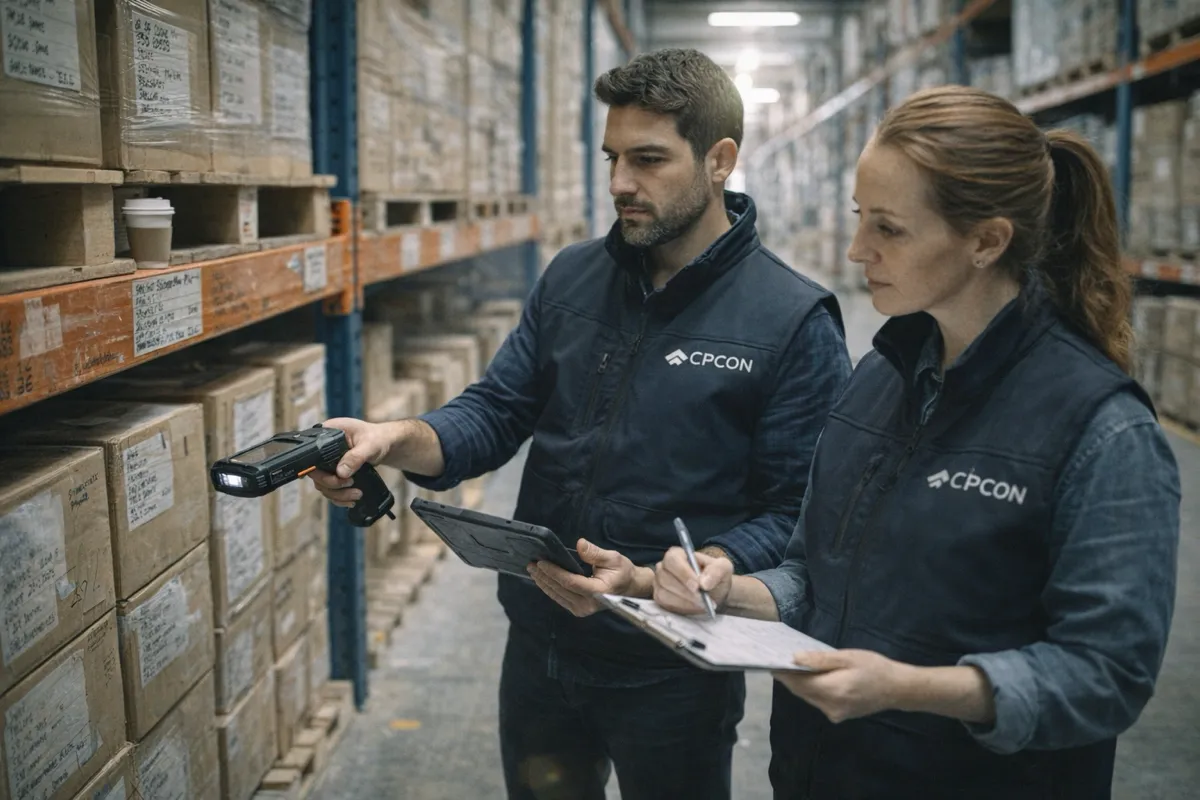
Substantiating the quantity behind an ASC 330 balance is an operational discipline, and many organizations bring in an independent partner to run it — either a full wall-to-wall count or an ongoing cycle-count program in a perpetual environment. This is precisely CPCON's lane. Our inventory counting services deliver independent, audit-grade quantities and condition data, captured with barcode or RFID scanning and reconciled to the subledger, so your accounting team can apply ASC 330's valuation rules to numbers they can trust.
To be clear about the division of labor: CPCON does not provide cost-accounting, overhead-absorption, or valuation services, and this guide is educational rather than accounting advice. Choosing cost-flow methods, building overhead pools, and recording NRV write-downs are the work of your controllers and auditors. What we provide is the independent physical count and reconciliation those valuations depend on — the same foundational role our ASC 360 verification work plays for fixed assets.
Common Inventory Accounting Errors
Most ASC 330 problems trace back to a small set of recurring issues:
- Quantity errors — perpetual records that no longer match the floor, the single most common driver of an inventory misstatement.
- Missed write-downs — obsolete, damaged, or slow-moving stock carried at full cost when NRV has fallen below it.
- Cut-off mistakes — goods received or shipped near period-end recorded in the wrong period, distorting both inventory and cost of goods sold.
- Inconsistent costing — applying a cost-flow method unevenly, or changing it without proper disclosure and justification.
- Unsupported balances — an inventory figure that cannot be tied back to a count, leaving the largest current asset resting on an estimate.
The first and last items on that list are quantity problems, not pricing problems — and they are solved on the warehouse floor, not in the general ledger. A defensible ASC 330 balance is the product of two disciplines working together: sound valuation by the accounting team, applied to an accurate, independently verified count. Get the count right, and the standard's valuation rules finally have something solid to stand on.